Art World insider Barbara T. Hoffman’s* guide to navigate the implications of current developments in art law as they relate to artists, collectors, galleries and museums, as well as a forum for the discussion of the implications of current events at the intersection of art, law, politics, and culture for the art world and beyond.
How the Paris Art Scene Resists When Democracy Falters
By Barbara Hoffman © November 04, 2025 I have returned to Paris often enough that the city is no longer a destination but a process of thinking. Arrival here is rarely neutral. As a student in the late 60’s in Paris, I supplemented my undergraduate exposure as an art historian and French major immersed in the literature and philosophy of the past from Racine, Pascal, Voltaire, Moliere, Balzac, Baudelaire, Rimbaud, Proust, Camus and Sartre, with the ground-breaking French philosophers and intellectuals of the time, several of whose classes I was privileged to attend. Claude Levi-Strauss and Jean Piaget, believed that human thought and behavior are based on underlying, universal structures. They shared a “structuralist” approach, focusing on the interconnected systems and relationships that shape mental and cultural phenomena. Michel Foucault’s philosophical work focused on the idea that knowledge and power are inseparable. All ideas convey power that alters human behavior, and institutions primarily serve as organized attempts to manipulate individuals for particular ends. Foucault criticized historical Western classical-liberal norms for concealing power impositions under the guise of humanitarianism and rationalism. Roland Barthes asserted that the meaning of a text or work is not limited to the author’s intention. On the contrary, it is multiple, shifting, and nourished by the interpretations of readers/viewers. French anthropologists, philosophers, psychologists, psychoanalysts, and poets - were radically changing how we understood the world, knowledge and humanism. These critical theories offered and urged acceptance of the challenge to denaturalize social, aesthetic and linguistic norms and open up new ways of seeing and acting upon the world. The 60’s and early 70’s were years of political trauma and uprising in France and the United States. For those who know the history, this is not the first time Paris has hosted the collision of art, law, and political upheaval. The spring of 1968 turned the Latin Quarter into a rehearsal space for new forms of public life — not just protests. Posters, slogans, manifestos, improvised cinemas, print shops, and collective seeing animated the courtyard of the Ecole des Beaux Arts and the streets which surrounded my neighborhood. Martin Luther King Jr. and Robert Kennedy were assassinated while I was in Paris during the events of 1968. Protests against racism, the war in Vietnam, attacks on homosexuals, and discrimination in employment and voting continued unabated on the streets and campuses in the USA. The lesson is not that 1968 can be repeated but that culture becomes political not when it demands agreement, but when it demands attention intended to provide the critical underpinnings and tools for dealing with the traumas caused by colonialism, racism, homophobia, misogyny. By demanding attention, culture, in this case as expressed through art, politics and law, encourages dialogue and reflection on these issues, offering philosophical frameworks and critical tools to navigate the complexities of identity, power, and justice. Paris in 2025 is not Paris in 1968. But the echo remains: art once again asks not what we think, but how we see.Paris in October: The Movable Feast and the Work of Seeing
Paris has always been a stage for art, politics, memory, and spectacle, a city where institutions narrate history and the streets rehearse its future. To come in late October or November is to enter a season when the art world contracts and intensifies at once. Museums unveil major exhibitions; fairs garner their markets and rituals. Even ordinary looking may be reframed and charged with consequence. Last year’s highlights were the successful recapture by Art Basel Paris of the recently restored Grand Palais, an Art Nouveau exhibition hall originally built for the 1900’s World Fair, and my restoration to the status of VIP d’Honneur 10 am, with access en principe to a BMW; Mark Rothko, at The Foundation Louis Vuitton, and the 100th anniversary celebrating the birth of Surrealism at the Centre Pompidou. This year, the question was not whether Paris might offer escape from the attacks on democracy and the rule of law occurring elsewhere. The city of light does not promise refuge. Paris draws us, like a magnet to the moveable feast of our youth, an ever- shifting confluence of action and theory, its bright beacon illuminating for all who choose to observe the dynamics of power, institutional responsibility, and the role of art in a destabilized civic order. To write from Paris in November 2025 is to write from a place where the spectacle of culture meets the machinery of law, where museums defend their relevance while markets define value faster than criticism can keep pace, and where the line between political event and cultural gesture grows thinner each season. It is also inevitable as a lawyer/observer to write through the lens as someone trained to unearth facts and observe process, watch where power collects, and how it is justified, resisted, or manipulated. But in October 2025, the city felt less like an ideal and more like a mirror: a place where the same pressures facing cultural institutions elsewhere—censorship, market capture, donor influence, political oversight, public exhaustion—are not avoided but exposed. The diary notes that follow are not a travelogue. They are a working record of how Paris stages the relationship between art and democracy at a time when both are under strain. In this season, the work of seeing is not passive. It is a civic act.The Art Fair Circuit: Does the Marketplace Become a Forum?
Every October, Paris becomes the temporary capital of the global art market. What has come to be known as Paris Art Week is a choreography of VIP previews, tiered access, speculative buying, institutional courting, and rapid valuation. Access is currency here, and status appears not as taste but as architecture suspended on the cliff of theater. Art Basel Paris (formerly FIAC) takes over the Grand Palais, and there are a host of satellite fairs: Paris Internationale and Asia Now in their tenth edition, as well as Offscreen in its fourth edition, are amongst my favorites. Offscreen, which highlights installations, and still and moving images, was founded by Julien Freydman, the former Magnum, then Paris Photo director. The late Shigeko Kubota pioneering Korean video artist, aka wife of Naim June Paik, was honored this year with an exhibition of video works, largely unknown in France. Offscreen was sited this year appropriately at the Chapelle Saint-Louis de la Salpêtrière, part of the historic complex founded by Louis XIV in 1656. It nudged out the Grand Palais as the most relevant architectural and politically resonant fair venue, in keeping with historical, aesthetic and philosophical themes of other exhibitions. The hospital is shrouded with a notorious history of the treatment of “mad women” and the diagnosis of hysteria in women. The latter is the legacy of nineteenth century Dr Jean-Martin Charcot whom the French recognize as the father of modern neurology. Charcot’s Iconographic Photographique de la Salpêtrière (1876-80) is a landmark publication in medical photography. This collection of texts and photographs represents the female patients of Dr. Charcot at the Salpêtrière hospital and asylum during the years of his tenure as director. His classroom presentations of female hysteria in his patients became theater spectacle for “toute Paris”, including Henri du Toulouse Lautrec, and students, like Sigmund Freud, who translated his work into German. The Surrealists as well as artists like Egon Schiele were also influenced by these studies. The lens of French Theory, particularly, Michel Foucault, was relevant historically in 1968 and is today, to provide a narrative to understanding this institution of madness and hysteria. So, too, is Convulsive States (2023), by video and performance artist Liz Magic Laser. Her original installation and exhibition at Pioneer Square in 2023, critically and brilliantly explored the shaking body as both a symptom and a cure for psychic distress, in part, through the artifice of a hallucinatory investigative report that feverishly pursues the cure for hysteria as it uncovers mysteries at the Salpêtrière.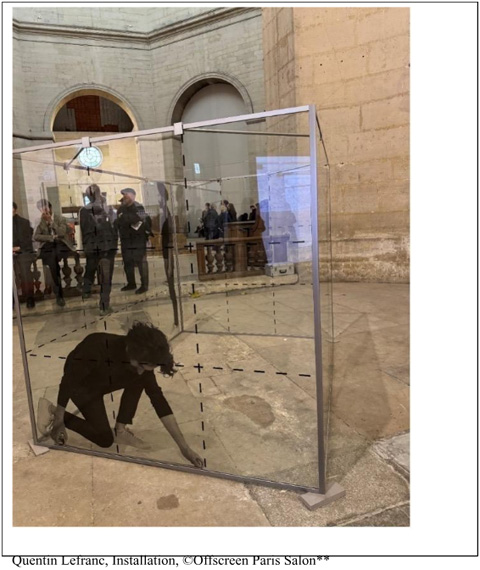 Offscreen offered many installations overtly or conceptually distinctly political charged. Not surprising, where the hospital’s control over bodies, women and other marginalized persons is embedded in the stones. The installation of Quentin Le Franc, which questions how art responds when democratic space contracts, seems particularly appropriate to the historical, social and cultural history of the site. The architecture serves as a framework, territory and playground for the installation to create a dialogue between the historical context and the artwork.
The Art Basel brand is unapologetically and successfully associated with quality and commerce: the Grand Palais is a perfect site for its ambitions. Yet, and through no fault of the architecture, any sense of community and collegiality is in the imagination. To the extent the VIP program of FIAC (Frances’s signature contemporary and modern art fair for 47 years, before the takeover), promoted this community and salon of ideas, it is lost in this art world dominated by mega-fairs and mega-sales, largely, one might imagine, for investments. Basel Paris has still to learn about how physical not virtual community and conversations promote sales and value. Without any training in the subject of psychoanalysis, I am at a loss to understand why attendees as Vip’s at Art Basel, mass at the gates and in the aisles like shoppers in search of a deal at “Black Friday”; yet to my knowledge never acknowledge their similitude or convergence with this other community of bargain hunters.
Paris’ satellite fairs thrive on something else: intimacy, inclusivity, experimentation, and belief in the potential and message of the artists represented.
Offscreen offered many installations overtly or conceptually distinctly political charged. Not surprising, where the hospital’s control over bodies, women and other marginalized persons is embedded in the stones. The installation of Quentin Le Franc, which questions how art responds when democratic space contracts, seems particularly appropriate to the historical, social and cultural history of the site. The architecture serves as a framework, territory and playground for the installation to create a dialogue between the historical context and the artwork.
The Art Basel brand is unapologetically and successfully associated with quality and commerce: the Grand Palais is a perfect site for its ambitions. Yet, and through no fault of the architecture, any sense of community and collegiality is in the imagination. To the extent the VIP program of FIAC (Frances’s signature contemporary and modern art fair for 47 years, before the takeover), promoted this community and salon of ideas, it is lost in this art world dominated by mega-fairs and mega-sales, largely, one might imagine, for investments. Basel Paris has still to learn about how physical not virtual community and conversations promote sales and value. Without any training in the subject of psychoanalysis, I am at a loss to understand why attendees as Vip’s at Art Basel, mass at the gates and in the aisles like shoppers in search of a deal at “Black Friday”; yet to my knowledge never acknowledge their similitude or convergence with this other community of bargain hunters.
Paris’ satellite fairs thrive on something else: intimacy, inclusivity, experimentation, and belief in the potential and message of the artists represented.
Museums, Memory and the Politics of Exhibition
If fairs are where value is made, museums are where meaning is negotiated. This season, several major Paris institutions mounted exhibitions that engage either explicitly, or implicitly with the question of historical memory and democratic fragility. Paris’s primarily government funded institutions, arguably were never neutral cultural terrain. The Louvre, Pompidou, Musée d ’Art Moderne, Quai d’Orsay, Palais de Tokyo were built not just to preserve art, but to define what counts as art, what counts as history, what merits exhibition and who is authorized to speak. In the past decades, at least three major private collections add different voices and perspectives, through the exhibition of works of their owners, commissioned works and loans for exhibitions. Obviously, these private institutions incorporated as museums or non-for-profit subsidiaries of luxury brands could not exist were it not for the luxury brands and the fortunes which fund their “owners” passions, tastes , collecting and exhibitions: The Cartier Foundation was founded in 1984; Bernard Arnault officially commissioned the Fondation Louis Vuitton, and the project was publicly announced in October 2006, after the concept and architect, Frank Gehry were selected in 2001; and the Pinault Collection founded 1999, Paris, 2021. All have block buster major exhibitions on view through January, 2026, with only the Cartier inaugural exhibition to coincide explicitly with the festivities of Paris Basel. Whether by coincidence or confluence, I noted a synergy amongst the various exhibitions selected for this article. Perhaps it is the convergence of the 100th year of the birth of Surrealism and the 100th of Art Deco. In October, 1925, the International Exhibition of Modern Decorative and Industrial Arts in Paris, marked the peak of Art Deco. Decorators, manufacturers, magazines, department stores, artists, and even foreign nations competed fiercely to occupy Parisian buildings or erect temporary structures to display their latest creations, at or adjacent to the selected site, the Grand Palais. The destabilization of the world order, attacks on the rule of law, the rise of fascism, conflicts, and genocide and the disappearance of facts as we know them, have provoked responses of the art world and the broader question of the role of the artist and art in these times. Several of the exhibitions may have been planned before the current authoritarian threats to democracy, specifically free speech and the press and denials of facts derived from credible documentary and scientific evidence. Can these exhibitions create a bridge between these alternative worlds and modes of thought? The artists and exhibitions on view provide remarkable and appropriate models for hope and transformation to a more equitable and harmonious world, whether such art is influenced and fueled by poetry, magic, imagination, Surrealism, French Theory, Buddhism or variants thereupon. Michel Foucault and Roland Barthes were significantly influenced by Surrealism, particularly in its challenge to rational thought and traditional structures of meaning. Surrealism, through its emphasis on the unconscious, dreams, and “pure psychic automatism,” sought to bypass conscious, rational control to access a deeper reality. This devaluation of the rational mind resonated with post-structuralist thinkers who critiqued the dominance of reason and objective truth in Western thought. Exhibitions in Paris reflect these historical trends of poetry and spirituality on the one hand and politics on the other.Palais de Tokyo —Echo, Delay, Reverb: American Art and Francophone Thought
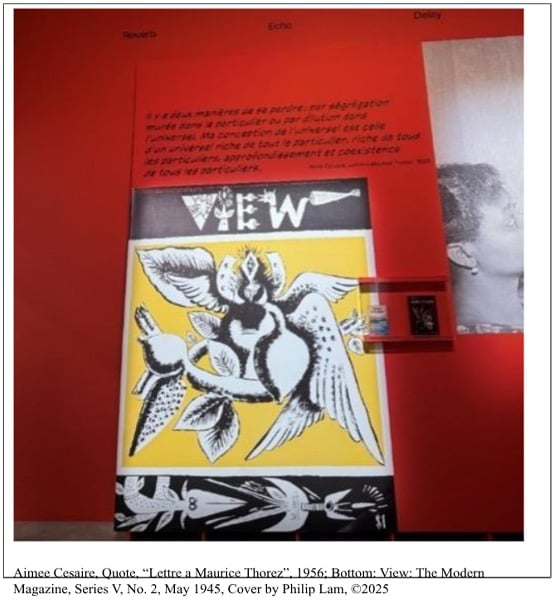
22 October 2025 – 15 February 2026, Artistic Director Naomi Beckwith and Elvan Zabunyan Curated as dialogue rather than thesis, Beckwith questions what happens when cultural history is not linear but recursive so images return but are altered by power. Even though I participated as a law professor in an academic group originating at the Harvard Law School inspired by French Theory in the 1980’s, called Critical Legal Theory, which included Professor Derrick Bell, the founder of critical race theory. The basic principle of critical theory imported from French theory is that the law and the legal system are not based on neutral principles but context and power based. Critical Theory birthed in Frankfurt, Germany, during the Nazi period, whose advocates included Juergen Habermas and Walter Benjamin; from the former, derives that the notion of the public sphere, the latter, the notion that “mechanical reproduction, through technologies like photography and film, strips an original work of its unique aura, fundamentally altering its function from being based on ritual to being based on politics and mass exhibition. Their influence was more profound on earlier generations of artists, art critics and art historians, through the 1980’s. in the United States, and of course on certain German artists. I was unaware of the huge impact Beckwith claims for French Theory on United States artists and artistic practice, having left the arena of academics in 1986.I was also unaware of the role played in the dissemination of French Theory by the Whitney Independent Study (ISP) Program. Beckwith is an alumna. The program has been suspended for 2026 by the chilling effect of President Trump’s attacks on wokeism, freedom of speech and artistic expression. In May, a performance at the Whitneyinvolving Palestine was also cancelled. Echo, Delay Reverb purports to show how artists in the United States catalyzed the revolutionary energies of thinkers who were by turn activists and poets – from Simon de Beauvoir, Michel Foucault and Jacques Derrida to Frantz Fanon, Jean Genet, Aimé Césaire, Monique Wittig, Pierre Bourdieu and Edouard Glissant – to transgress genres and shift perspectives on the world today. Beckwith’s thesis is that reading the work of these authors helped artists in the United States to translate their ideas into unexpected forms and to forge tools with which critique institutions of the art world and of society as a whole. For them, theory has not been a gloss but a powerful impetus for denaturalizing social, aesthetic and linguistic norms and opening up new ways of seeing and acting upon the world. A chilling effect has not prevented the excellent resource and text book (not a catalogue) which accompanies the exhibition. It pays homage to Palestine and its flag in red, black, white and green, is in memory of Felix Gonzalez Torres an alumnus of ISP who created an artwork on this theme, and is offered as a tool kit for resistance and hope in this chaotic time.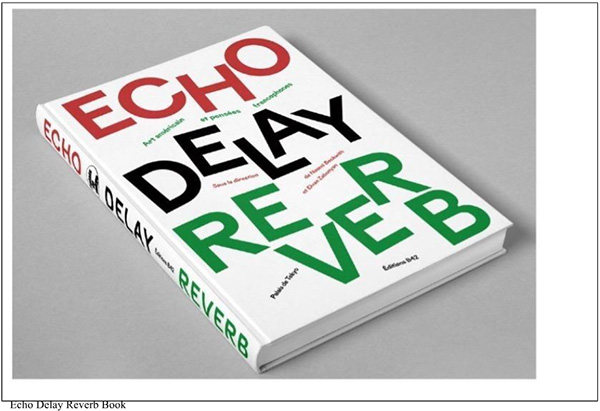
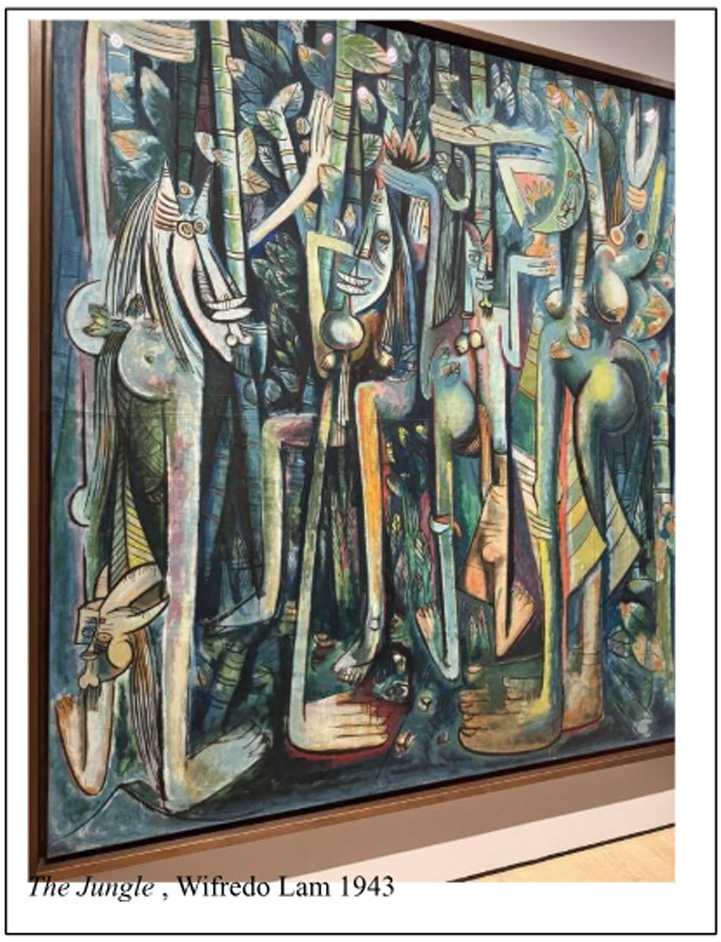
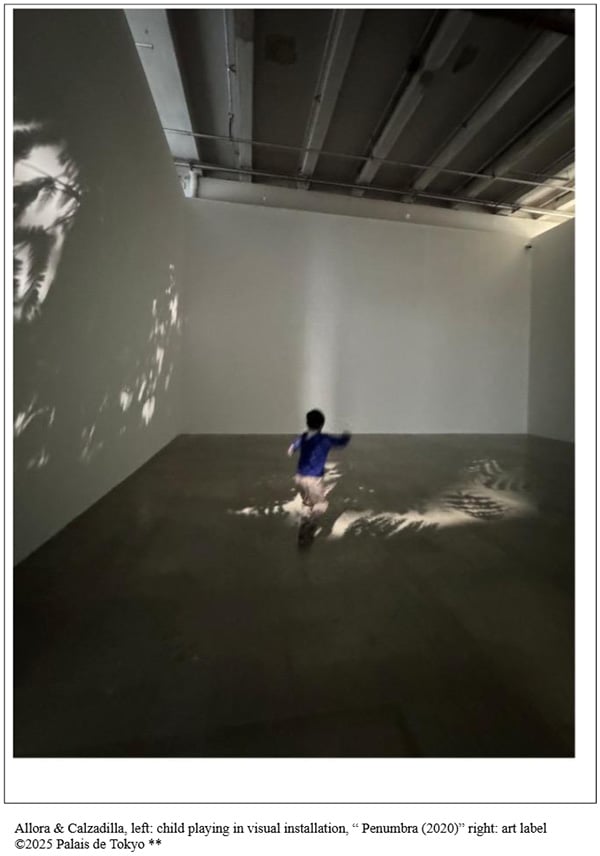 This work of Allora & Calzadilla references and pays homage to a meeting of which took place in Martinque at a stopover in a ship in April 1941 between a group of artists and writers: Surrealist Andre Breton, Wifredo Lam and Claude Levi Strauss, and Martinican poets Suzanne and Aime Cesaire, fleeing from Nazi occupied France. Lam and Aimé Césaire and they formed a lasting friendship, inspired by Cesaire's Tropiques magazine and his poem Cahier d'un retour au pays natal. I was fascinated by this installation and its historic evocation. Delving deeper in Ai, I learned that, unlike the wall label which suggests after the principal meeting the group went hiking together which greatly influenced their subsequent art and writings, the exiles were interred in a holding camp “Bel Air” for forty days. Lam returned to Cuba, where the influence of the encounter in the jungle is said to have inspired The Jungle, 1943 (see Part 2) and his deep commitment to poetry and Surrealism.
 While Beckwith only suggests the influence of Surrealism poetry, spiritualism and magic on contemporary artists of color in the United States. magic, and poetry on contemporary African American artists, the decision allocate adjacent space to a retrospective of Mel Edwards, provides the perfect bookend to the narrative.
The same year that Jungle was created, the writer Benjamin Péret’s contribution to a 1943 issue of Tropiques was in the form of a preface to Césaire’s poem “Cahier d’un retour au pays natal,” which was illustrated by Lam. “For the first time,” Péret wrote, “a tropical voice resounds in our language, not to mediate an exotic poetry, trinket of bad taste and mediocre interior, but to burst out in an authentic poetry issuing from the rotting trunks of orchids and the electric butterflies devouring carrion…
His poetry has the sovereign allure of the great breadfruit trees and the obsessive accent of the voodoo drums. In it, black magic heavy with poetry is opposed to the point of rebellion against the religions of the slavers where all magic is mummified, all poetry dead forever. (quoted in Tropiques 6-7 [Feb. 1943], p. 60).
Echo Delay Reverb, while not giving attention explicitly to Surrealism, finds some of the qualities linked to emotion, poetry in politics in sections labeled “Desiring Machines” and” Abjection.” Regarding the latter, the text states that The book Powers of Horror (1980) by philosopher and psychoanalyst Julia Kristeva popularized the notion of the abject in the United States. At its core, the abject reflects conditions of existence: in the 1980s, marked by the AIDS epidemic, an imaginary of regression and catastrophe resurfaced within a society marked by the violence of neoliberal economics on certain populations.
“David Hammons, Cindy Sherman and Mike Kelly embraced “abjection” in the 1970s and 1980s, as did Pope. L, whose monumental installation The Polis or the Garden or Human Nature in Action (1998–2025) has been reactivated for the exhibition: 1,200 onions painted in primary colors arranged on tables will sprout and eventually rot, in an allegory of life as resistance to social and nationalist order.”
While Beckwith only suggests the influence of Surrealism poetry, spiritualism and magic on contemporary artists of color in the United States. magic, and poetry on contemporary African American artists, the decision allocate adjacent space to a retrospective of Mel Edwards, provides the perfect bookend to the narrative.
The same year that Jungle was created, the writer Benjamin Péret’s contribution to a 1943 issue of Tropiques was in the form of a preface to Césaire’s poem “Cahier d’un retour au pays natal,” which was illustrated by Lam. “For the first time,” Péret wrote, “a tropical voice resounds in our language, not to mediate an exotic poetry, trinket of bad taste and mediocre interior, but to burst out in an authentic poetry issuing from the rotting trunks of orchids and the electric butterflies devouring carrion…
His poetry has the sovereign allure of the great breadfruit trees and the obsessive accent of the voodoo drums. In it, black magic heavy with poetry is opposed to the point of rebellion against the religions of the slavers where all magic is mummified, all poetry dead forever. (quoted in Tropiques 6-7 [Feb. 1943], p. 60).
Echo Delay Reverb, while not giving attention explicitly to Surrealism, finds some of the qualities linked to emotion, poetry in politics in sections labeled “Desiring Machines” and” Abjection.” Regarding the latter, the text states that The book Powers of Horror (1980) by philosopher and psychoanalyst Julia Kristeva popularized the notion of the abject in the United States. At its core, the abject reflects conditions of existence: in the 1980s, marked by the AIDS epidemic, an imaginary of regression and catastrophe resurfaced within a society marked by the violence of neoliberal economics on certain populations.
“David Hammons, Cindy Sherman and Mike Kelly embraced “abjection” in the 1970s and 1980s, as did Pope. L, whose monumental installation The Polis or the Garden or Human Nature in Action (1998–2025) has been reactivated for the exhibition: 1,200 onions painted in primary colors arranged on tables will sprout and eventually rot, in an allegory of life as resistance to social and nationalist order.”
Pope.L, Polis or the Garden or Human Nature in Action, 1998/2015. View of the exhibition “William Pope.L - Trinket”, The Geffen Contemporary at MOCA (Los Angeles), 2015 Courtesy Pope.L Estate, credit: Barbara Hoffman
Melvin Edwards — Palais de Tokyo
Part of the “Echo, Delay, Reverb” season After Nazism, the Eurocentric conception of the human as a central value was challenged by many postwar intellectuals. Frantz Fanon, a philosopher and psychiatrist from Martinique with the seminal Wretched of the Earth (1961)as well as the poets of Négritude Aimé Césaire, with his Discourse on Colonialism (1950), Suzanne Césaire, and Négritude co-founder, the poet Léon-Gontram Damas from French Guiana ,contributed to this critique of humanism by highlighting the dehumanizing character of the colonial and racist project that structures Western societies. Mel Edwards was a close friend of Damas and dedicated a major five-part work, Homage to the Poet Léon-Gontram Damas (1978-1981) (pictured below), to him. This connection highlights the influence of Négritude's ideas, which centered on affirming Black identity and culture against the backdrop of French colonialism and universalism, on Edwards' practice. Edwards’ long-standing sculptural language—barbed wire, welded steel, forms evoking captivity and resistance can be read differently in 2025: the question is no longer how violence is remembered, but how it is normalized.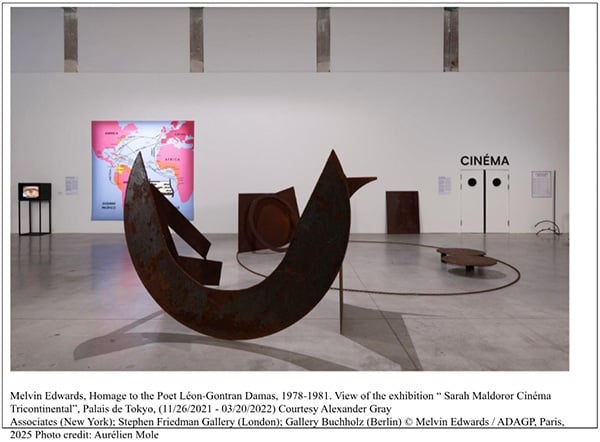
The Poetics of Resistance: Beyond Identity, Beyond Didacticism
If the Palais de Tokyo exhibition is undergirded with theory—structural, academic, curatorial—another artistic response has emerged in Paris this season: a poetics rather than a manifesto. An amalgam of French theory, surrealism, in varying degrees, these artists, turn toward imagination, and poetics rather than argument. While art may be understood as post didactic, it is not post-political,. Artists who refuse to reduce themselves to representation yet refuse to abandon the political stake of the moment. This is visible across several exhibitions, but most clearly in three figures whose work moves past identity categories while being inspired by culture and context, to forge something speculative, visionary or poetic.- Stephanie Jemison — artist-in-residence, Galeries Lafayette Anticipation
- Gerhard Richter — retrospective at Fondation Louis Vuitton
- George Condo — retrospective at Musée d’Art Moderne
Stephanie Jemison — Galeries Lafayette Anticipation (2025–26 season)
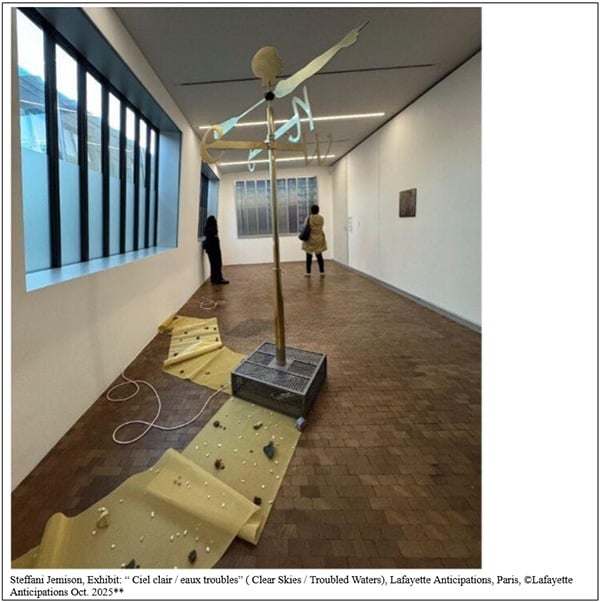 Jemison’s work treats language, gesture and futurity as forms of refusal. Her films, texts and performances engage Afrofuturism not as fantasy but as method: a way to make space where dominant narratives refuse it.
Rather than depict identity, she disassembles it—turning the viewer from spectator into decoder. Jemison is one of the clearest reminders that art does not need to choose between politics and poetry; it can make politics legible only through poetry.
This installation is a powerful interweaving of physical phenomena with histories of Black liberation and political resistance. It transforms the gallery space into a site for profound reflection on the visible and invisible forces that shape human movement and memory. In 1831, Nat Turner, a plantation slave in Virginia, witnessed an eclipse, interpreting it as a sign for rebellion. Clear Skies/ Troubled Waters examines revolt and repression from 1831 to race riots in Boston Newark and Detroit in the summer of 1967 through natural phenomena (eclipses, wind patterns, variations in light and gravity).
Jemison’s work treats language, gesture and futurity as forms of refusal. Her films, texts and performances engage Afrofuturism not as fantasy but as method: a way to make space where dominant narratives refuse it.
Rather than depict identity, she disassembles it—turning the viewer from spectator into decoder. Jemison is one of the clearest reminders that art does not need to choose between politics and poetry; it can make politics legible only through poetry.
This installation is a powerful interweaving of physical phenomena with histories of Black liberation and political resistance. It transforms the gallery space into a site for profound reflection on the visible and invisible forces that shape human movement and memory. In 1831, Nat Turner, a plantation slave in Virginia, witnessed an eclipse, interpreting it as a sign for rebellion. Clear Skies/ Troubled Waters examines revolt and repression from 1831 to race riots in Boston Newark and Detroit in the summer of 1967 through natural phenomena (eclipses, wind patterns, variations in light and gravity).
Gerhard Richter — Foundation Louis Vuitton
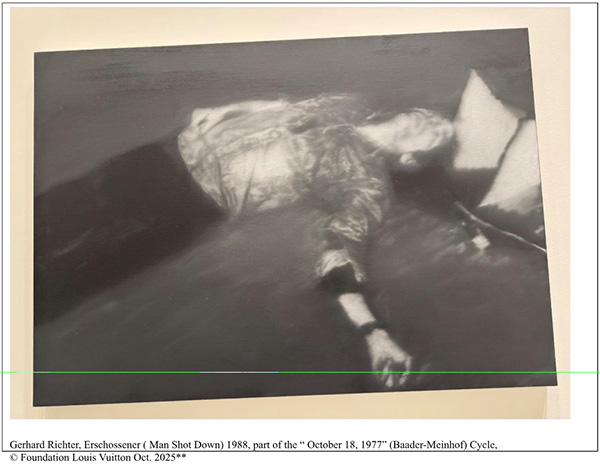
17 October 2025 – 2 March 2026 A six-decade retrospective, including the politically loaded 18 October 1977 cycle—Richter’s blurred images of the Red Army Faction suicides in German prison. Once controversial, now newly resonant in an age when state violence is both hyper-visible and structurally denied. Richter famously said: “Art is the highest form of hope.” These are not contradictions. They are twin recognitions: that truth is fugitive, and hope requires form. Richter’s abstractions do not resolve history—they hold it in suspension.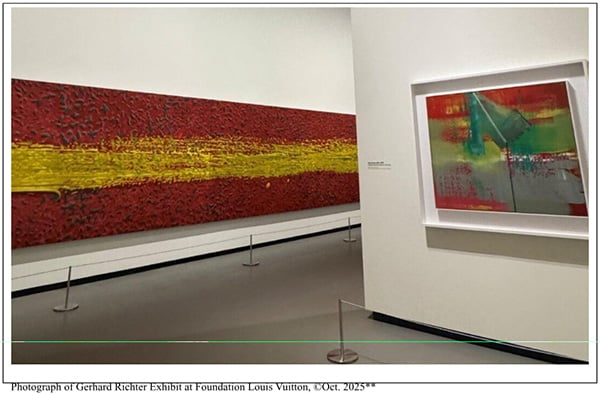
George Condo — Musée d’Art Moderne de Paris
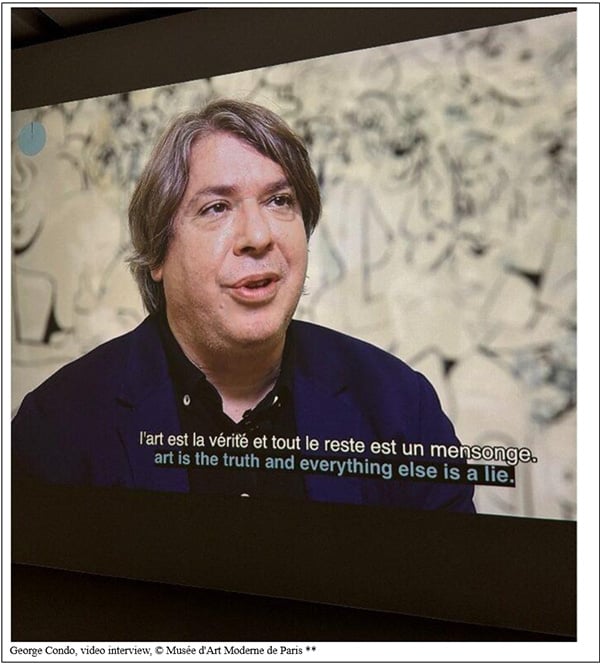
10 October 2025 – 8 February 2026 Condo states that he views his art as a psychological exploration of human nature, utilizing art historical language and the actualization of philosophical content. Condo has lived in Paris, and has referenced French theorists, including reading Gilles Deleuze and Felix Guattari’s analysis of Francis Bacon. His work has also been discussed in the context of Georges Bataille’s ideas of transgression and the questioning of certainties. At a discussion at Hauser and Wirth in February of this year when asked about the current US political situation and attacks on freedom of expression, he stated. “This is sort of a moment in politics where, you know, without really discussing politics, that people just sit there and wonder, am I gonna be allowed to be what I am and do what I want to do?... Who is going to come along and set me free from this situation that we’re in,” he said.”… Art offers a powerful antidote to political constraint. As an artist, you can do that with your art, and art has that power to liberate its subjects from any kind of constraints that may be imposed by any form of, you know, let’s call it political disaster,” he said.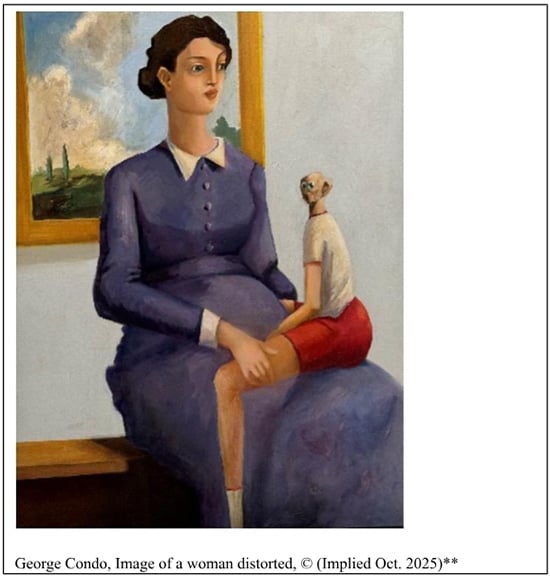 His figures, distorted but unmistakably human, resemble not political portraits but the emotional ruins politics leaves behind.
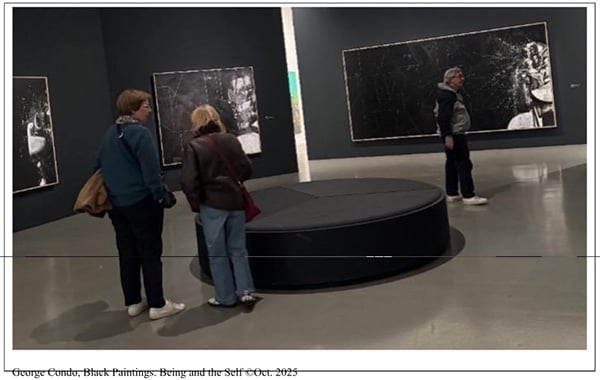 Condo’s Black Series—Expressionism twisted into psychological architecture—returns at a moment when fracture has become a global norm. His figures, distorted but unmistakably human, resemble not political portraits but the emotional ruins politics leaves behind. Particularly suitable to our current political crisis of democracy, in his black paintings, George Condo explores themes of the human condition, psychological fragmentation, and the tension between chaos and control.
If democracy is faltering, Condo’s paintings show the internal weather of that collapse. Not critique, but aftermath.
Condo’s Black Series—Expressionism twisted into psychological architecture—returns at a moment when fracture has become a global norm. His figures, distorted but unmistakably human, resemble not political portraits but the emotional ruins politics leaves behind. Particularly suitable to our current political crisis of democracy, in his black paintings, George Condo explores themes of the human condition, psychological fragmentation, and the tension between chaos and control.
If democracy is faltering, Condo’s paintings show the internal weather of that collapse. Not critique, but aftermath.
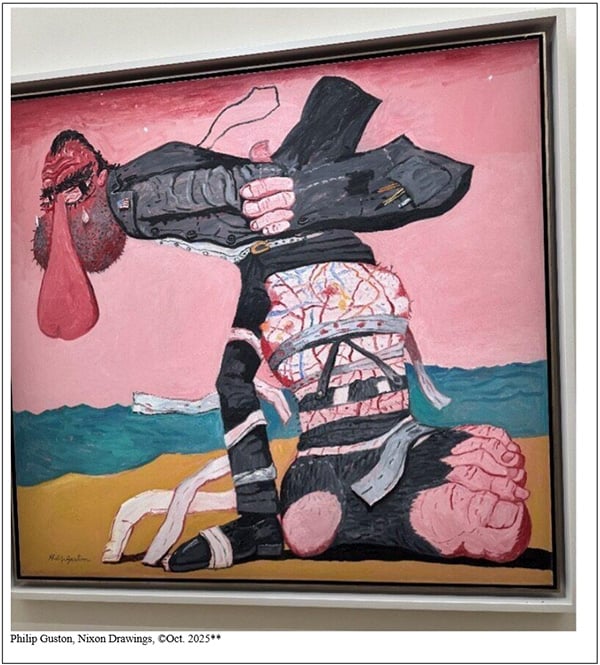
Philip Guston — Musée Picasso
14 October 2025 – 1 March 2026 Once delayed for fear of public controversy, the Guston exhibition now lands in a world where controversy is constant, and avoidance looks like complicity. The hooded figures return—not as symbols of race alone, but as warnings about what happens when violence goes unexamined long enough to become cartoon. The museum now asks viewers not whether the work is offensive, but whether our being unoffended has made us politically numb. As important, at the book store of the Museum, I found two books of Walter Benjamin, as books relevant to the exhibition. I purchased Benjamin's famous essay, “The Work of Art in the Age of Mechanical Reproduction”. Philip Guston was directly familiar with Walter Benjamin's writings, particularly his concept of “art as ruin” and theory of allegory, and referenced them in conversation, though there is no evidence the two ever met.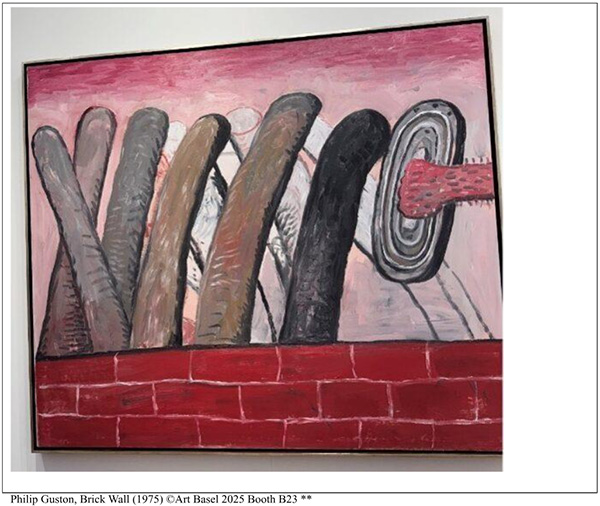
Architecture, Memory and the City as Argument
Paris is not just a city of exhibitions but of enacted arguments. Architecture functions here as a legal brief in stone—declaring what is private, what is public, what is preserved, and what is permitted to disappear.Cité de l’Architecture — Paris 1925: Art Deco and Its Architects
22 October 2025 – 29 March 2026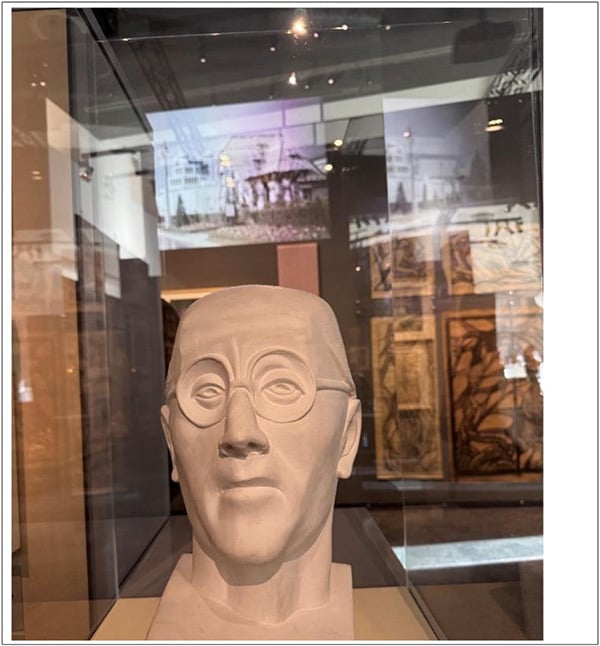
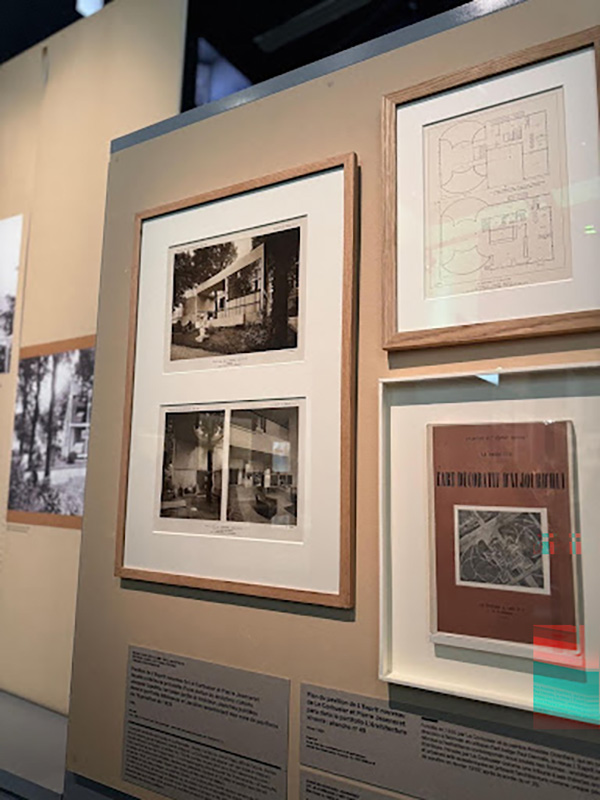 A centenary exhibition marking Art Deco not as nostalgia but as a reminder that style is never apolitical. Art Deco was the aesthetic of interwar optimism—and of rising authoritarianism. The show includes works by Le Corbusier and others whose visions of order now appear double-edged: utopian, and disciplining.
From 28 April to 30 November 1925, the Exposition Internationale des Arts Décoratifs was held in Paris, on or near the grounds of the Grand Palais where each country presented its most emblematic achievements in the decorative arts in temporary pavilions.
There were two opposing architectural movements: the Art Deco style and the modernist movement, also known as the international avant-garde.
Le Corbusier and Pierre Jeanneret were given a plot of land behind the Grand Palais for their project. His model scandalized the organizers by its modernism and commitment to low-cost modular housing. He also submitted a radical plan of urbanism for redoing Paris.
A centenary exhibition marking Art Deco not as nostalgia but as a reminder that style is never apolitical. Art Deco was the aesthetic of interwar optimism—and of rising authoritarianism. The show includes works by Le Corbusier and others whose visions of order now appear double-edged: utopian, and disciplining.
From 28 April to 30 November 1925, the Exposition Internationale des Arts Décoratifs was held in Paris, on or near the grounds of the Grand Palais where each country presented its most emblematic achievements in the decorative arts in temporary pavilions.
There were two opposing architectural movements: the Art Deco style and the modernist movement, also known as the international avant-garde.
Le Corbusier and Pierre Jeanneret were given a plot of land behind the Grand Palais for their project. His model scandalized the organizers by its modernism and commitment to low-cost modular housing. He also submitted a radical plan of urbanism for redoing Paris.
Fondation Cartier pour l’ Art Contemporain,
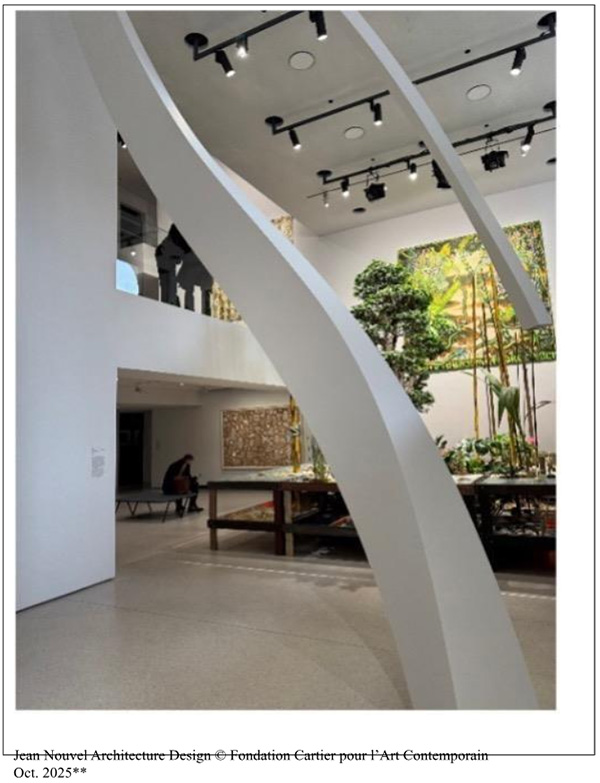
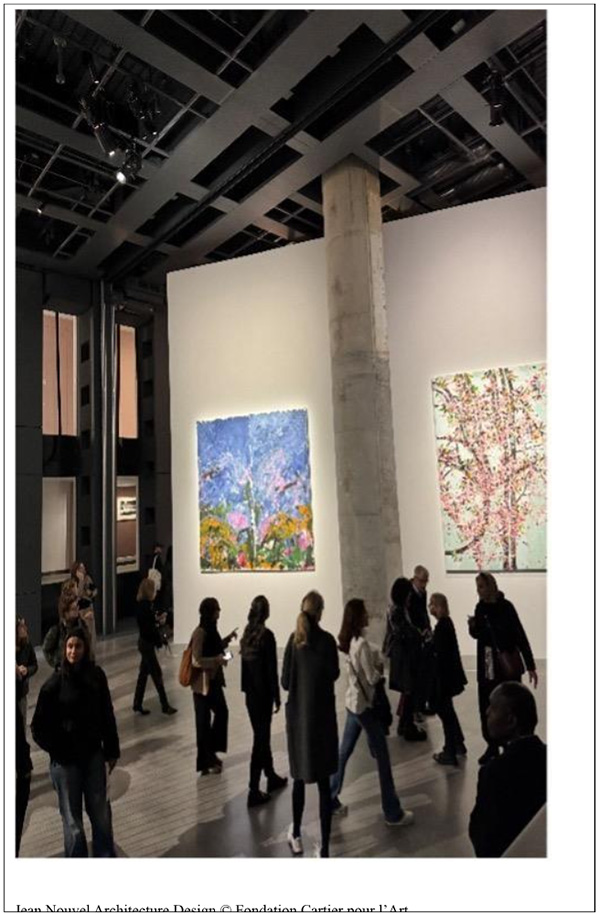
Exposition Générale, August 23, 2026 Cartier’s new venue, 2 Place du Palais-Royal is a radical overhaul of the interior of the five-story Haussmann- era block, which was originally built in 1855 as the Grand Hôtel du Louvre, before becoming the Grands Magasins du Louvre. Jean Nouvel, also designed the foundation's previous iconic glass building on Boulevard Raspail. The inaugural exhibition, which opened October 25 showcases 40 years of the foundation's history through approximately 600 works by over 100 artists. Nouvel’s design, once dismissed as spectacle, now reads as a proposition: museums must be legible from the outside or risk becoming citadels: glass, permeability, and civic transparency as architectural thesis. f The design emphasizes openness to the city with vast bay windows and glass roofs, creating a “fishbowl-like effect” where the urban landscape becomes part of the exhibition experience. Nouvel made the 5 floors entirely movable, both walls and heights to suit an installation or an exhibition. For many of us, this caused a slightly panicked experience as the rationality of traditional architecture and structural design was no longer a guide to our trajectory and we struggled in the dark to find a path to the elevator or exit. Perhaps that is the message: Democracy may involve chaos and lack of a clear path in its trade-off with authoritarianism. Freedom has a price. Democracy calls for attention. Looked at in another way, Ateliers Jean Nouvel studio director Mathieu Forest at the press preview explained, “It's unprecedented…Nothing is permanent – not the floor, not the walls, not the ceiling,” he continued. “You visit and then next time you may have an entirely different perspective.” What is remarkably interesting in the current exhibition of commissions over the years, is its diversity in the selection of artists from around the world, diversity in medium and out-of-the-box thinking of contemporary art. This is not market-driven art. The architecture of Nouvel seeks to mirror its spirit: the collection is forward looking, inclusive and prescient of the direction of art to come in a world of rapid change, technology, AI and globalism, climate threats, and an uncertain future.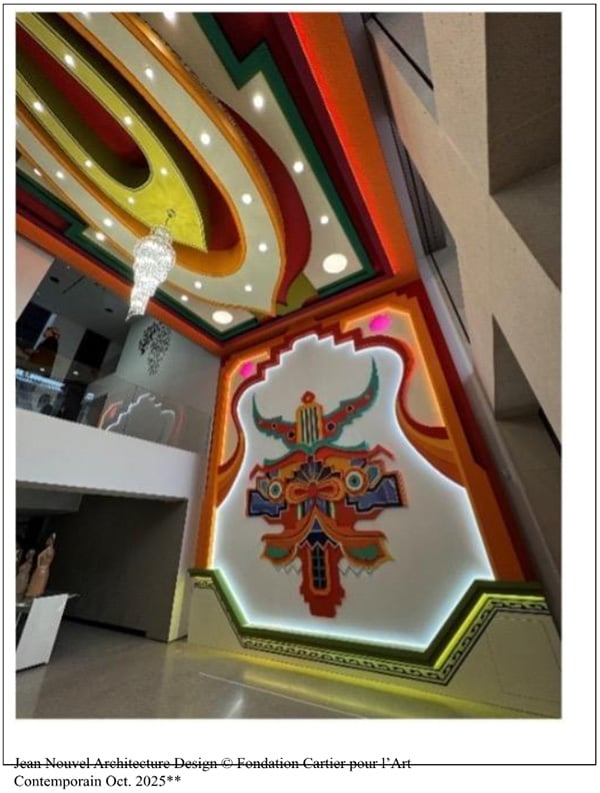
Pinault Collection — Bourse de Commerce
Minimal — 8 October 2025 – 19 January 2026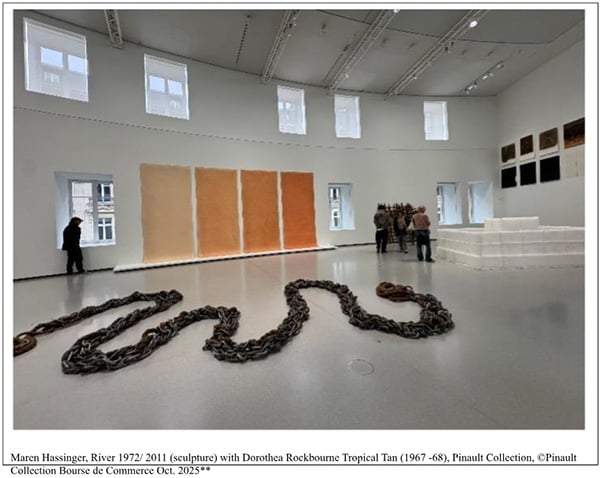 The “Minimal “exhibition at the Pinault Collection's Bourse de Commerce in Paris explores the global and international evolution of this movement, which since the early 1960s, has radically reconsidered the status of artwork. As the catalogue states: the movement is characterized by an economy of means, pared-down aesthetics, and a reconsideration of the artwork’s placement in relation to the viewer. Artists across Asia, Europe, North and South America challenged traditional methods of display. This approach invited a more direct, bodily interaction with the art, integrating the viewer and the environment into the artwork itself.
The Minimal exhibition is a counterweight to the spectacle of the fair. Minimal stages quietness as resistance: works by Judd, Kawara, Ryman, LeWitt, Dorthea Rockbourne, Maren Hassinger and Howardena Pindell refuse narrative, refuse speed, refuse distraction. In a season of overstimulated publics, the exhibition proposes attention as a political ace. As with Cartier, the exhibition, which is composed largely of Pinault’s collection, is avant-garde in the number of women artists over 50 who only recently have gained the prominence and market deserved.
If democracy depends on attention, then attention must be trained — slowly, deliberately, against the market’s velocity.
The “Minimal “exhibition at the Pinault Collection's Bourse de Commerce in Paris explores the global and international evolution of this movement, which since the early 1960s, has radically reconsidered the status of artwork. As the catalogue states: the movement is characterized by an economy of means, pared-down aesthetics, and a reconsideration of the artwork’s placement in relation to the viewer. Artists across Asia, Europe, North and South America challenged traditional methods of display. This approach invited a more direct, bodily interaction with the art, integrating the viewer and the environment into the artwork itself.
The Minimal exhibition is a counterweight to the spectacle of the fair. Minimal stages quietness as resistance: works by Judd, Kawara, Ryman, LeWitt, Dorthea Rockbourne, Maren Hassinger and Howardena Pindell refuse narrative, refuse speed, refuse distraction. In a season of overstimulated publics, the exhibition proposes attention as a political ace. As with Cartier, the exhibition, which is composed largely of Pinault’s collection, is avant-garde in the number of women artists over 50 who only recently have gained the prominence and market deserved.
If democracy depends on attention, then attention must be trained — slowly, deliberately, against the market’s velocity.
The American Parallel: 2024 and the Shrinking Democratic Imagination
Across the Atlantic, the 2024 U.S. election showed what happens when democracy is treated as spectacle instead of structure. Legal systems bent, norms disappeared, fiction and fantasy replaced facts, and institutions once thought stable became stage sets for power. Since Trump’s Executive Orders, multiple American museums were attacked — not with fire, but with funding withdrawals, board interventions, legislative threats, and demands for “neutrality” that were anything but neutral. The cancellation of several Smithsonian exhibitions, would be based on my understanding of constitutional law for ten years in a law school, unconstitutional. The suspension of the ISP are unconstitutional but the current Court arguably has a different redacted copy of the Constitution and case reporters. As in the 1990’s a chilling effect has spread to cultural institutions: the ISP program has been cancelled for next year and a performance based on Palestine, cancelled in May. Although beyond discussion in this Diary, it would nevertheless be remiss to fail to mention that in New York, Philadelphia and elsewhere, there evidence in the form of “must see exhibitions” of “The Poetics of Resistance: Beyond Identity, Beyond Didacticism”. I mention in passing, the brilliant retrospectives, of Coco Fusco, Rashid Johnson, Wifredo Lam, Man Ray and the 100-year celebration of surrealism of Philadelphia to offer up vision as to art, politics and cultures can resist this moment of authoritarianism and provide a path to a democratic and inclusive future powered by imagination now.The Politics of Attendance
To attend an exhibition now is not a cultural act alone. It is a civic one. Showing up to the museum, the fair, the talk, the archive is a declaration that public space still matters, that meaning is not fully privatized, that art still functions as more than asset class or décor. Absence, too, is political and institutions feel it. In a world where attention is monetized, the decision to give it freely is a form of rebellion.Conclusion — The Lawyer-Observer Writes from Paris
 If critique is the labor of attention, hope is its companion. Not naïve hope, but procedural hope. The kind that knows democracy is not guaranteed, that the law is not self-enforcing, that culture is not automatically public, but must be defended every season, every exhibition, every time we choose to look rather than scroll past.
Paris does not offer answers, only rehearsals.
It teaches us that art is not evidence, but inquiry. That museums are not mausoleums, but arguments. That fairs are not just markets, but weather reports for the emotional economy of a civilization under stress. That architecture remembers what politics forgets. That the work of seeing is still a public duty. That the poetry, meditation and imagination of artists like Coco Fusco, Jen de Nike and Stepfani Jemison can take us to another exterior level where alternative universes created by different facts transform at a level where the universe begins to acknowledge the oneness of all living beings and that we are all part of a giant ecosystem of life in the universe.
And so, the phrase returns, not as nostalgia but as instruction:
A movable feast.
Not a celebration, but a practice. Not a refuge, but a rehearsal.
Not an escape from history, but a way of looking at it without surrender.
If critique is the labor of attention, hope is its companion. Not naïve hope, but procedural hope. The kind that knows democracy is not guaranteed, that the law is not self-enforcing, that culture is not automatically public, but must be defended every season, every exhibition, every time we choose to look rather than scroll past.
Paris does not offer answers, only rehearsals.
It teaches us that art is not evidence, but inquiry. That museums are not mausoleums, but arguments. That fairs are not just markets, but weather reports for the emotional economy of a civilization under stress. That architecture remembers what politics forgets. That the work of seeing is still a public duty. That the poetry, meditation and imagination of artists like Coco Fusco, Jen de Nike and Stepfani Jemison can take us to another exterior level where alternative universes created by different facts transform at a level where the universe begins to acknowledge the oneness of all living beings and that we are all part of a giant ecosystem of life in the universe.
And so, the phrase returns, not as nostalgia but as instruction:
A movable feast.
Not a celebration, but a practice. Not a refuge, but a rehearsal.
Not an escape from history, but a way of looking at it without surrender.
Art is the highest form of hope.
— Gerhard Richter, Documenta 7 in Kassel, 1982. Barbara Hoffman
Barbara T. Hoffman is recognized internationally and nationally as one of the preeminent art, intellectual property, and cultural heritage lawyers. With more than forty years of practice in every aspect of the field, Hoffman has been acknowledged by her peers with leadership positions in the New York City Bar Association and International Bar Association, elected to Super Lawyers, Best Lawyers.]]>
Barbara Hoffman
Barbara T. Hoffman is recognized internationally and nationally as one of the preeminent art, intellectual property, and cultural heritage lawyers. With more than forty years of practice in every aspect of the field, Hoffman has been acknowledged by her peers with leadership positions in the New York City Bar Association and International Bar Association, elected to Super Lawyers, Best Lawyers.]]> The Hoffman Law Firm's The Art Lawyer's Diary by an art world insider is a guide to navigating the implications of current developments in art law as they relate to artists, collectors, galleries, and museums, as well as a forum for the discussion of the implications of current events at the intersection of art, law politics, and culture for the art world and beyond.
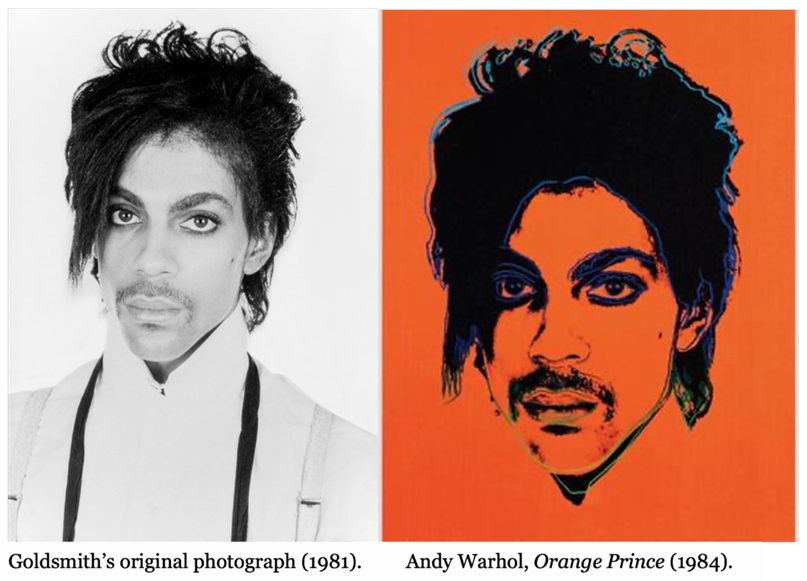 The Supreme Court's affirmation of the Second Circuit's decision is a welcome correction to the importation of the "famous artist exception" argued by the AWF; that is, that appropriation artists get a free pass to use copyrighted material as facts of popular culture without commenting on the original work and without paying the customary price. To state it another way, the Court rejects the bright line rule argued by the AWF and its supporters (i.e., Amicus Curiae of Art Law Professors) that the fair use doctrine does not comport with the First Amendment if it does not permit the public to use facts, ideas, and expression itself, if it creates a new meaning and message as Warhol clearly did.
One Art Nation, for whom I write regularly, requested my commentary on the Supreme Court decision. The Art Lawyer's Diary: Lots of Smoke and No Fire as Goldsmith Prevails Against Warhol Foundation in the Supreme Court provides an in-depth analysis and historic context for the decision.
This commentary adds a more personal note based on my involvement and success in litigating fair use cases on behalf of photojournalists and visual artists whose works have been used without permission on a theory of fair use.
The doctrine of fair use permits and requires courts to avoid rigid application of the copyright statute, when, on occasion, it would stifle the very creativity that the law is designed to foster. In determining whether a particular use is protected under the doctrine, courts are to apply an "equitable rule of reason" analysis, guided by these four factors:
The Supreme Court's affirmation of the Second Circuit's decision is a welcome correction to the importation of the "famous artist exception" argued by the AWF; that is, that appropriation artists get a free pass to use copyrighted material as facts of popular culture without commenting on the original work and without paying the customary price. To state it another way, the Court rejects the bright line rule argued by the AWF and its supporters (i.e., Amicus Curiae of Art Law Professors) that the fair use doctrine does not comport with the First Amendment if it does not permit the public to use facts, ideas, and expression itself, if it creates a new meaning and message as Warhol clearly did.
One Art Nation, for whom I write regularly, requested my commentary on the Supreme Court decision. The Art Lawyer's Diary: Lots of Smoke and No Fire as Goldsmith Prevails Against Warhol Foundation in the Supreme Court provides an in-depth analysis and historic context for the decision.
This commentary adds a more personal note based on my involvement and success in litigating fair use cases on behalf of photojournalists and visual artists whose works have been used without permission on a theory of fair use.
The doctrine of fair use permits and requires courts to avoid rigid application of the copyright statute, when, on occasion, it would stifle the very creativity that the law is designed to foster. In determining whether a particular use is protected under the doctrine, courts are to apply an "equitable rule of reason" analysis, guided by these four factors:
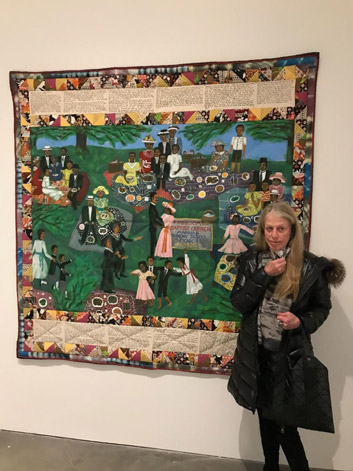
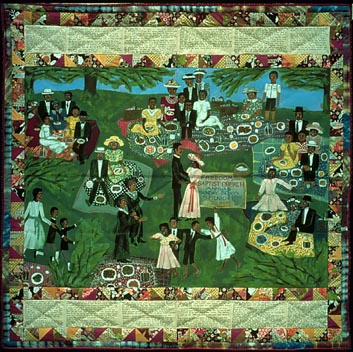
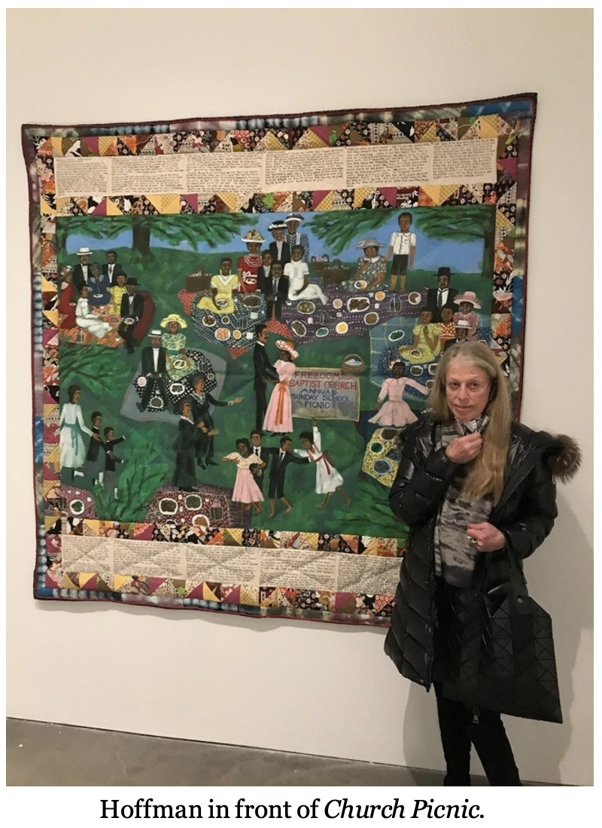 I litigated for the artist Faith Ringgold in the case of Ringgold v. Black Entertainment Television (BET) in 1997. Faith’s husband Bertie had seen an episode of the TV sitcom Roc. In the last five minutes of the episode, a poster licensed by Ringgold for production by the High Museum of Art in Atlanta, which owned the original “Church Picnic Story Quilt” (1988), appeared on a church wall as set dressing. However, the poster’s copyright text is too small for a television viewer to discern. Ringgold alleged that a poster of her work was used in the set’s decoration without copyright permission by Home Box Office (HBO) and BET. I cautioned that a series of district court precedents had failed to accord proper protection to the use of art in film and, notwithstanding the commercial aspects of the use, that the use did not satisfy the aforementioned factor one of criticism or scholarship. The lower courts had failed to protect visual arts with the same vigilance as music in films, primarily because visual artists
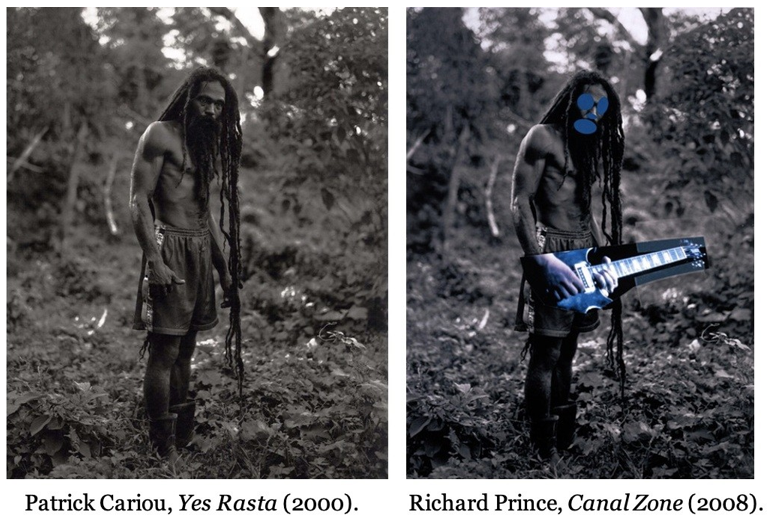 By 2009, however, the concept of transformative use had muddied the waters. The preamble purposes and whether the work was for commercial purposes and the burden placed on the second user had almost disappeared, swallowed up by a transformative use analysis that threatened, in particular, the copyrights of photographers and their right to license derivative works. The watershed which lead to the district court’s analysis in Warhol was anticipated by the flawed analysis in Cariou v. Prince (2013). In 2009, artist Richard Prince was sued by French photographer Patrick Cariou for copyright infringement after his “Canal Zone” paintings incorporated photographs from Cariou’s 2000 book Yes, Rasta. In March 2011, a US district judge ruled — in my view, correctly — against Prince on the basis of Campbell and ordered the defendant to destroy any unsold paintings that borrowed imagery from Cariou. That ruling was largely overturned on appeal a year later, apart from five paintings that were ordered to be reevaluated for claims of fair use. Museums lined up with Prince to argue an apocalyptic vision of artistic creation if Prince could not use Cariou’s work. Professor Amy Adler was paid by Prince’s team and was the source of a new standard embodying the “famous artist exception,” justified as an incentive for creating new work by famous artists with no mention of paying the customary price.
 Faith Ringgold, Church Picnic Story Quilt (1988).
 Hoffman in front of Church Picnic.
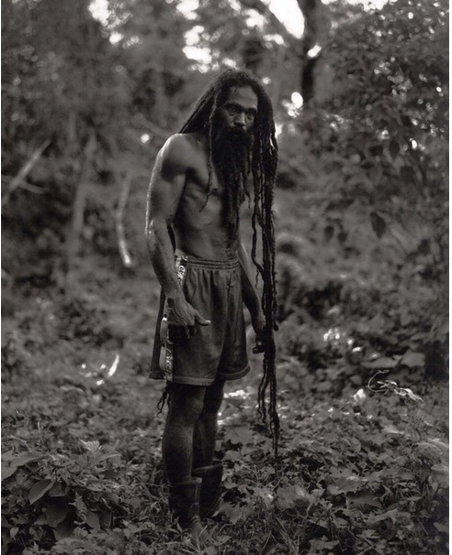 Patrick Cariou, Yes Rasta (2000).
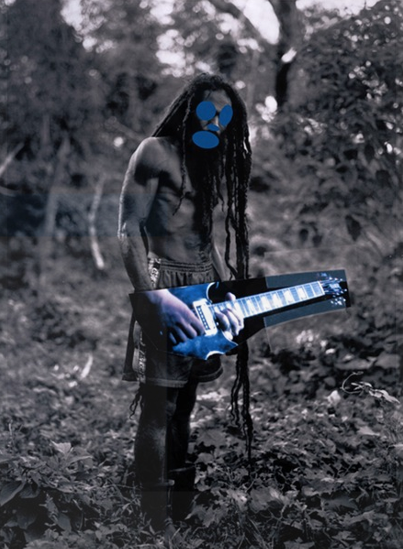 Richard Prince, Canal Zone (2008).
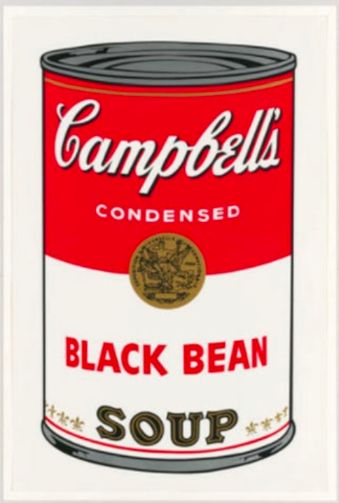 Andy Warhol, Campbell’s Soup I (Black Bean) (1968).
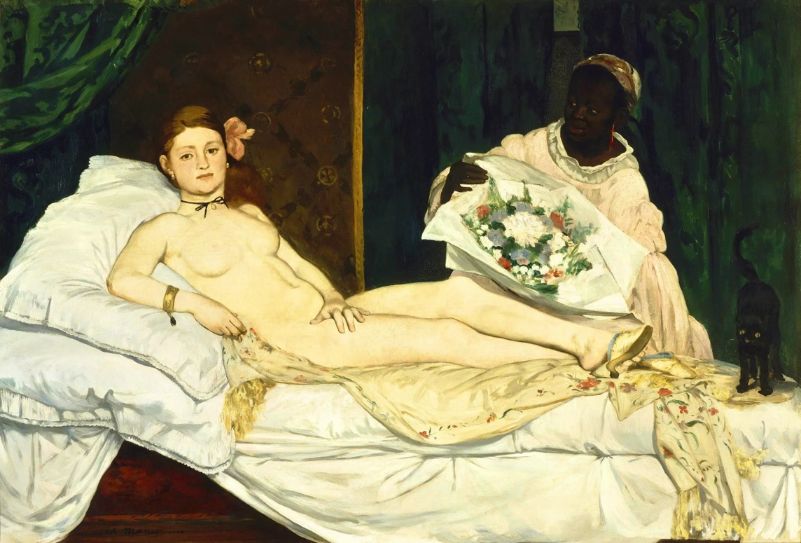 Titian, Venus of Urbino (1480/85 – 1576).
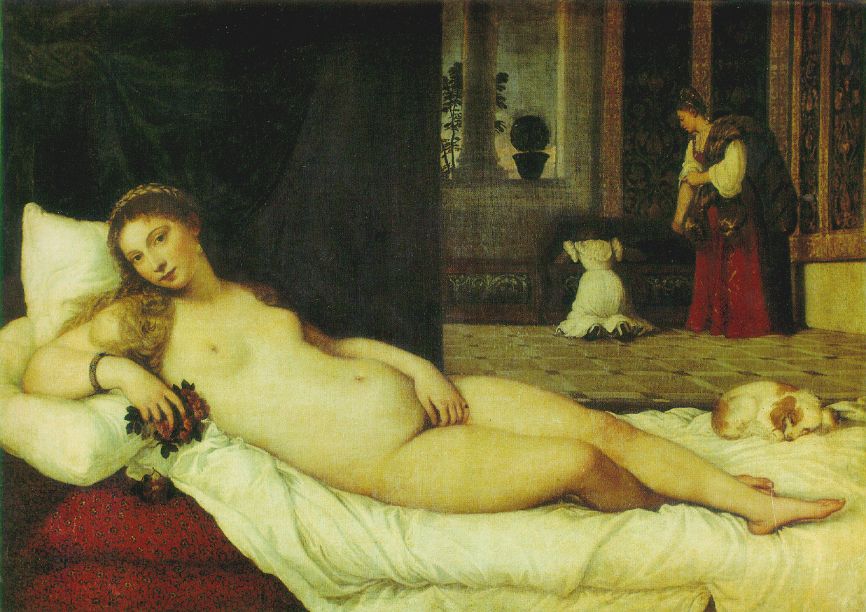 Manet, Olympia (1863).
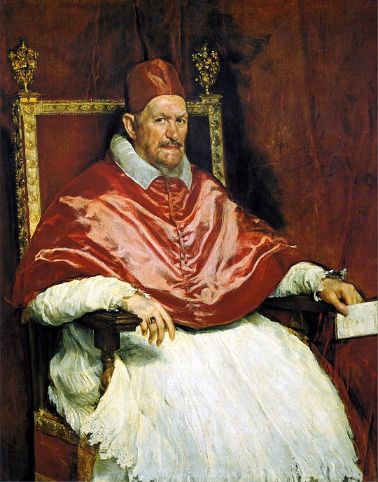 Diego Velázquez, Innocent Pope X (c. 1650).
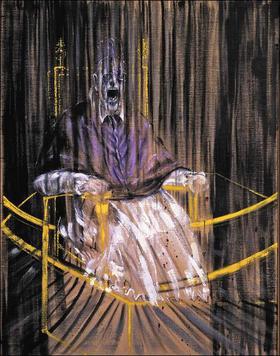 Francis Bacon, Study after Velázquez’s Portrait of Pope Innocent X (1953).
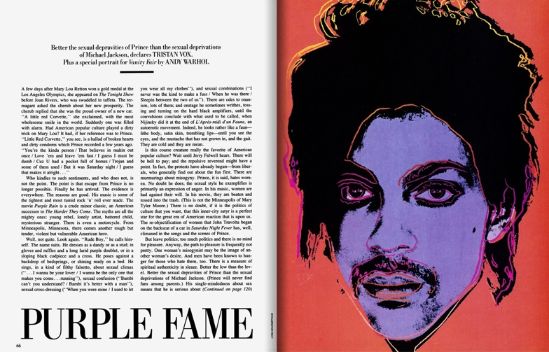 Francis Bacon, Study after Velázquez’s Portrait of Pope Innocent X (1953).
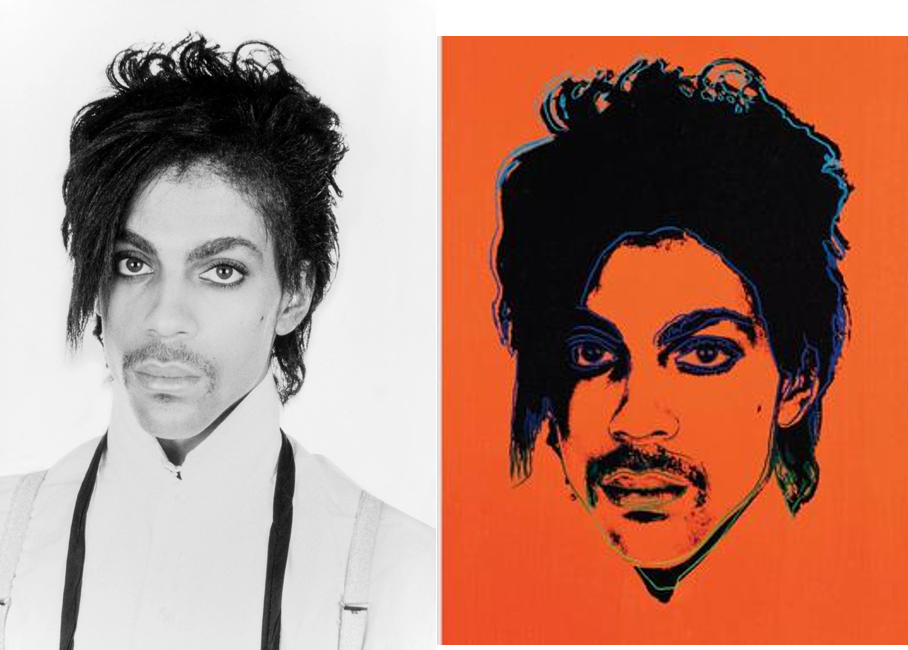
Oral argument in the Second Circuit Court of Appeals in the Andy Warhol Foundation v. Goldsmith took place on September 15, 2020. In the lower court (The Andy Warhol Foundation for the Visual Arts, Inc. v. Goldsmith et al.) Judge Koeltl of the SDNY, incorrectly in my opinion, decided on a motion for summary judgment (there were no disputes as to the facts), that Andy Warhol’s silk screen images of Prince which copied noted portrait photographer Lynn Goldsmith’s image of Prince, did not constitute copyright infringement. On July 1, 2019, Judge Koeltl ruled that when Andy Warhol copied an unpublished photographic portrait of the late singer Prince, (allegedly provided to him by Vanity Fair as a resource), and created 16 different variations of the unpublished photo, that these were “fair use” and not copyright infringement. Plaintiff, Andy Warhol Foundation for the Visual Arts, immediately praised the decision saying “Warhol is one of the most important artists of the 20th century, and we’re pleased that the court recognized his invaluable contribution to the arts and upheld these works.”
"Fair use" is a statutory affirmative defense to copyright infringement. 17 U.S.C. § 107. "The four factors identified by Congress as especially relevant in determining whether the use was fair are: (1) the purpose and character of the use; (2) the nature of the copyrighted work; (3) the substantiality of the portion used in relation to the copyrighted work as a whole; (4) the effect on the potential market for or value of the copyrighted work." The critical question in determining fair use is whether copyright law's goal of "promot[ing] the Progress of Science and useful Arts would be better served by allowing the use than by preventing it.” To make that determination, the Supreme Court has articulated in the case of Campbell v. Acuff Rose that one work transforms another when "the new work . . . adds something new, with a further purpose or different character, altering the first with new expression, meaning or message.” Although transformation is a key factor in fair use analysis under the first factor, whether a work is transformative is often a highly contentious topic, more often applied when it appears to justify a conclusion rather than operating as a bright line rule of law.
Of course, an artist’s celebrity status is not a factor to be considered under the weighing of the fair use factors under Section 107; for that misunderstanding, one needs to look at the sharply criticized and debated 2013 decision of the Second Circuit in Cariou v. Prince, its most recent articulation of the muddled and murky fair use doctrine. Cariou published Yes Rasta, a book of portraits and landscape photographs taken in Jamaica. Defendant celebrity appropriation artist Richard Prince who altered and incorporated several of plaintiff’s photographs into a series of paintings and collages called Canal Zone that was exhibited at a gallery and in the gallery’s exhibition catalog. The issue was whether defendant’s appropriation artwork, which incorporated the plaintiff’s original photographs, must comment on, relate to the historical context of, or critically refer back to the plaintiff’s original work in order to qualify for a fair use defense.
The Second Circuit found Prince’s uses to be fair, and that a secondary use does not need to comment on or critique the original in order to be transformative as long as it produces a new message. While Cariou’s book of 9 ½” x 12” black-and-white photographs depicted the serene natural beauty of Rastafarians and their environment, Prince’s work featured enormous collages on canvas that incorporated color and distorted human forms to create a radically different aesthetic. The Second Circuit found Prince’s work to be a transformative fair use of Cariou’s photographs. Whether or not art is transformative depends on how it may “reasonably be perceived, and not on the artist’s intentions.”
As a District Court Judge, Koeltl was bound to follow Cariou: in sum, the Prince Series works are transformative. They "have a different character, give [Goldsmith's] photograph a new expression, and employ new aesthetics with creative and communicative results distinct from [Goldsmith's]." See Cariou, 714 F.3d at 708. They add something new to the world of art and the public would be deprived of this contribution if the works could not be distributed. The first fair use factor accordingly weighs strongly in AWF's favor.
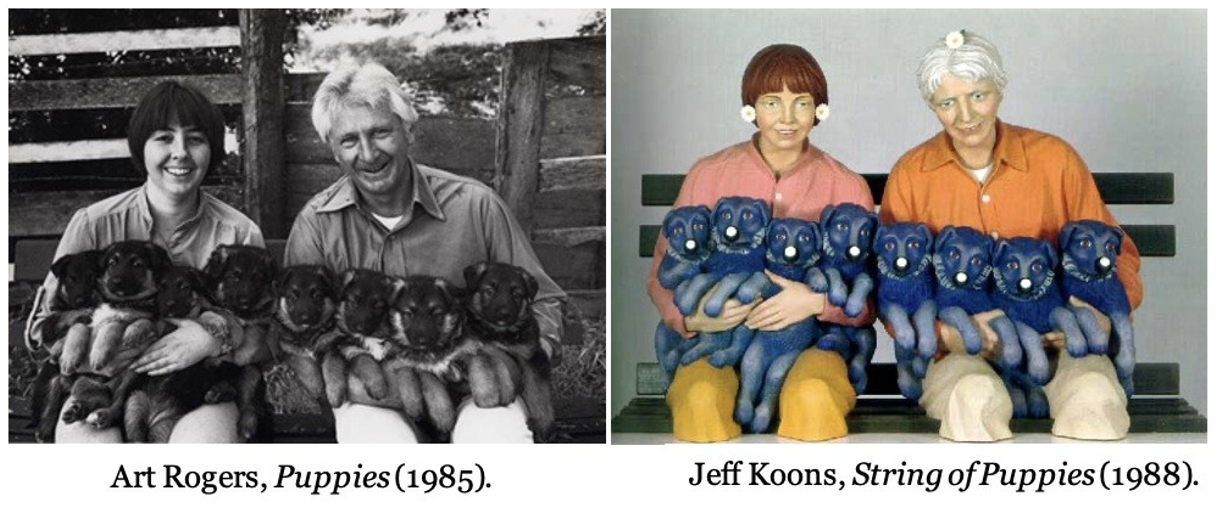
In finding Warhol’s use transformative, the circuit court denies protection to those elements of a photographic portrait that are protected by copyright law, as if the fair use defense to copyright infringement and the concept of celebrity transformative use literally erases “substantial similarity” and fails to appreciate how extensively Warhol’s silkscreen is derivative of – and a misappropriation of—protected expression from Lynn Goldsmith’s photographic portrait of Prince. It is difficult to reconcile the district court’s lack of solicitude for such camera-related choices in Goldsmith’s portrait of Prince with the Second Circuit’s 1992 decision in Rogers v. Koons, finding that “protectible elements of originality in a photograph may include posing the subjects, lighting, angle, selection of film and camera, evoking the desired expression, and almost any other variant involved.”
Francis Bacon, Study after Velázquez’s Portrait of Pope Innocent X (1953).
Oral argument in the Second Circuit Court of Appeals in the Andy Warhol Foundation v. Goldsmith took place on September 15, 2020. In the lower court (The Andy Warhol Foundation for the Visual Arts, Inc. v. Goldsmith et al.) Judge Koeltl of the SDNY, incorrectly in my opinion, decided on a motion for summary judgment (there were no disputes as to the facts), that Andy Warhol’s silk screen images of Prince which copied noted portrait photographer Lynn Goldsmith’s image of Prince, did not constitute copyright infringement. On July 1, 2019, Judge Koeltl ruled that when Andy Warhol copied an unpublished photographic portrait of the late singer Prince, (allegedly provided to him by Vanity Fair as a resource), and created 16 different variations of the unpublished photo, that these were “fair use” and not copyright infringement. Plaintiff, Andy Warhol Foundation for the Visual Arts, immediately praised the decision saying “Warhol is one of the most important artists of the 20th century, and we’re pleased that the court recognized his invaluable contribution to the arts and upheld these works.”
"Fair use" is a statutory affirmative defense to copyright infringement. 17 U.S.C. § 107. "The four factors identified by Congress as especially relevant in determining whether the use was fair are: (1) the purpose and character of the use; (2) the nature of the copyrighted work; (3) the substantiality of the portion used in relation to the copyrighted work as a whole; (4) the effect on the potential market for or value of the copyrighted work." The critical question in determining fair use is whether copyright law's goal of "promot[ing] the Progress of Science and useful Arts would be better served by allowing the use than by preventing it.” To make that determination, the Supreme Court has articulated in the case of Campbell v. Acuff Rose that one work transforms another when "the new work . . . adds something new, with a further purpose or different character, altering the first with new expression, meaning or message.” Although transformation is a key factor in fair use analysis under the first factor, whether a work is transformative is often a highly contentious topic, more often applied when it appears to justify a conclusion rather than operating as a bright line rule of law.
Of course, an artist’s celebrity status is not a factor to be considered under the weighing of the fair use factors under Section 107; for that misunderstanding, one needs to look at the sharply criticized and debated 2013 decision of the Second Circuit in Cariou v. Prince, its most recent articulation of the muddled and murky fair use doctrine. Cariou published Yes Rasta, a book of portraits and landscape photographs taken in Jamaica. Defendant celebrity appropriation artist Richard Prince who altered and incorporated several of plaintiff’s photographs into a series of paintings and collages called Canal Zone that was exhibited at a gallery and in the gallery’s exhibition catalog. The issue was whether defendant’s appropriation artwork, which incorporated the plaintiff’s original photographs, must comment on, relate to the historical context of, or critically refer back to the plaintiff’s original work in order to qualify for a fair use defense.
The Second Circuit found Prince’s uses to be fair, and that a secondary use does not need to comment on or critique the original in order to be transformative as long as it produces a new message. While Cariou’s book of 9 ½” x 12” black-and-white photographs depicted the serene natural beauty of Rastafarians and their environment, Prince’s work featured enormous collages on canvas that incorporated color and distorted human forms to create a radically different aesthetic. The Second Circuit found Prince’s work to be a transformative fair use of Cariou’s photographs. Whether or not art is transformative depends on how it may “reasonably be perceived, and not on the artist’s intentions.”
As a District Court Judge, Koeltl was bound to follow Cariou: in sum, the Prince Series works are transformative. They "have a different character, give [Goldsmith's] photograph a new expression, and employ new aesthetics with creative and communicative results distinct from [Goldsmith's]." See Cariou, 714 F.3d at 708. They add something new to the world of art and the public would be deprived of this contribution if the works could not be distributed. The first fair use factor accordingly weighs strongly in AWF's favor.
In finding Warhol’s use transformative, the circuit court denies protection to those elements of a photographic portrait that are protected by copyright law, as if the fair use defense to copyright infringement and the concept of celebrity transformative use literally erases “substantial similarity” and fails to appreciate how extensively Warhol’s silkscreen is derivative of – and a misappropriation of—protected expression from Lynn Goldsmith’s photographic portrait of Prince. It is difficult to reconcile the district court’s lack of solicitude for such camera-related choices in Goldsmith’s portrait of Prince with the Second Circuit’s 1992 decision in Rogers v. Koons, finding that “protectible elements of originality in a photograph may include posing the subjects, lighting, angle, selection of film and camera, evoking the desired expression, and almost any other variant involved.”
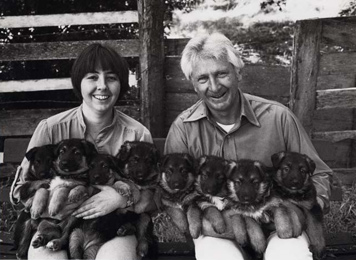
 Art Rogers, Puppies (1985).
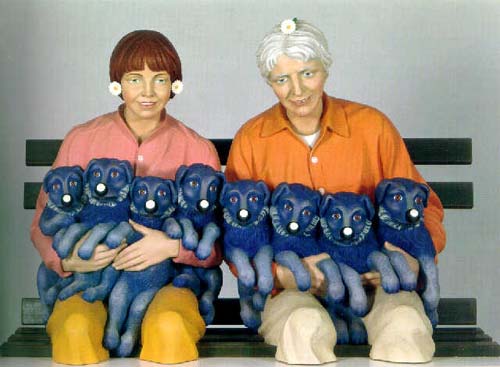
 Jeff Koons, String of Puppies (1988).
In October 1984, Vanity Fair licensed one of Goldsmith's black-and-white studio portraits of Prince from her December 3, 1981 shoot (the "Goldsmith Prince Photograph") for $400. The article stated that it featured "a special portrait for Vanity Fair by ANDY WARHOL." The article contained a copyright attribution credit for the portrait as follows: "source photograph © 1984 by Lynn Goldsmith/LGI."
Based on the Goldsmith Prince Photograph, Warhol created the "Prince Series," comprised of sixteen distinct works — including the one used in Vanity Fair magazine — depicting Prince's head and a small portion of his neckline.
Prince died on April 21, 2016. The next day, Vanity Fair published an online copy of its November 1984 "Purple Fame" article, which had credited Warhol and Goldsmith for the Prince illustration in the article. Condé Nast then decided to issue a commemorative magazine titled "The Genius of Prince" and obtained a commercial license to use one of Warhol's Prince Series works as the magazine's cover. The magazine contained a copyright credit to Warhol but not to Goldsmith. Condé Nast published the magazine in May 2016.
--------
* Barbara T. Hoffman is an art world insider, and a preeminent art and copyright lawyer with decades of experience. She has served as Chair of the City Bar Association Committee on Art Law, and on the IBA Committee on Art Cultural Institutions and Heritage Law. She has been selected to Super Lawyers and Best Lawyers in Copyright and Art Law since 2010, founded the WVLA and litigated the precedent-setting Ringgold v. BET and AFP v. Morel. The Art Lawyer’s Diary is Hoffman’s guide to navigating the implications of current developments in art law as they relate to artists, collectors, galleries, and museums, as well as a forum for the discussion of the implications of current events at the intersection of art, law, politics, and culture for the art world and beyond. www.hoffmanlawfirm.org.
Jeff Koons, String of Puppies (1988).
In October 1984, Vanity Fair licensed one of Goldsmith's black-and-white studio portraits of Prince from her December 3, 1981 shoot (the "Goldsmith Prince Photograph") for $400. The article stated that it featured "a special portrait for Vanity Fair by ANDY WARHOL." The article contained a copyright attribution credit for the portrait as follows: "source photograph © 1984 by Lynn Goldsmith/LGI."
Based on the Goldsmith Prince Photograph, Warhol created the "Prince Series," comprised of sixteen distinct works — including the one used in Vanity Fair magazine — depicting Prince's head and a small portion of his neckline.
Prince died on April 21, 2016. The next day, Vanity Fair published an online copy of its November 1984 "Purple Fame" article, which had credited Warhol and Goldsmith for the Prince illustration in the article. Condé Nast then decided to issue a commemorative magazine titled "The Genius of Prince" and obtained a commercial license to use one of Warhol's Prince Series works as the magazine's cover. The magazine contained a copyright credit to Warhol but not to Goldsmith. Condé Nast published the magazine in May 2016.
--------
* Barbara T. Hoffman is an art world insider, and a preeminent art and copyright lawyer with decades of experience. She has served as Chair of the City Bar Association Committee on Art Law, and on the IBA Committee on Art Cultural Institutions and Heritage Law. She has been selected to Super Lawyers and Best Lawyers in Copyright and Art Law since 2010, founded the WVLA and litigated the precedent-setting Ringgold v. BET and AFP v. Morel. The Art Lawyer’s Diary is Hoffman’s guide to navigating the implications of current developments in art law as they relate to artists, collectors, galleries, and museums, as well as a forum for the discussion of the implications of current events at the intersection of art, law, politics, and culture for the art world and beyond. www.hoffmanlawfirm.org.
 ]]>
]]>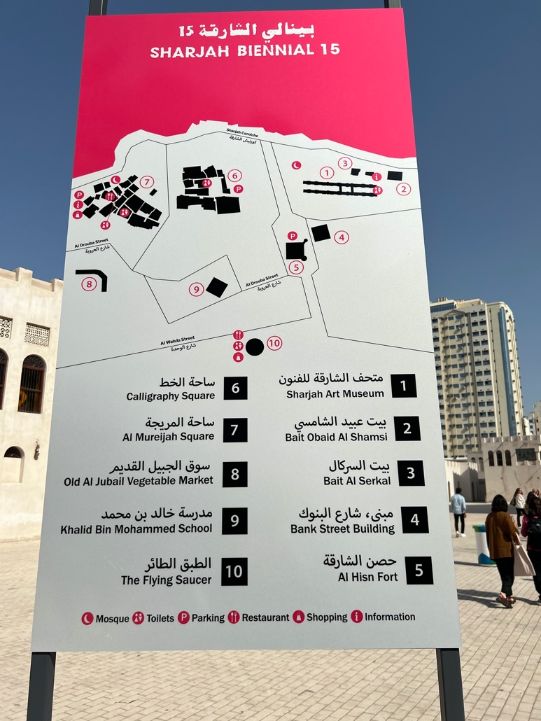 Map of Sharjah Biennial 15.
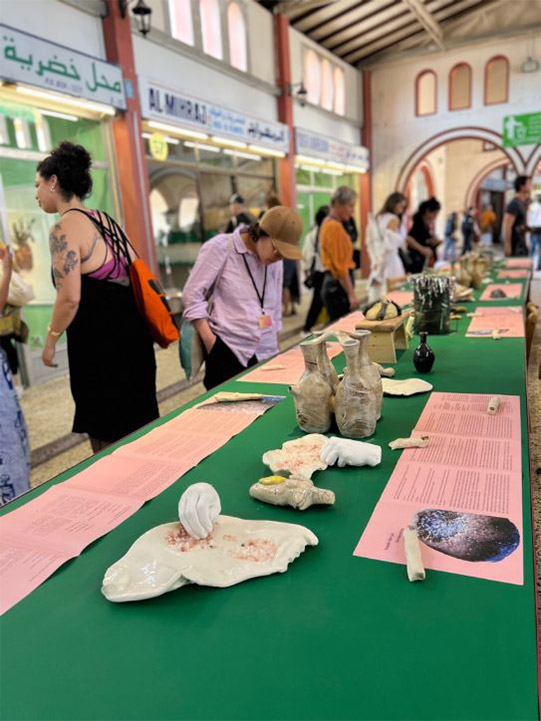 Mirna Bamieh, Sour Things (2023) on view at the Old Al Jubail Vegetable Market.
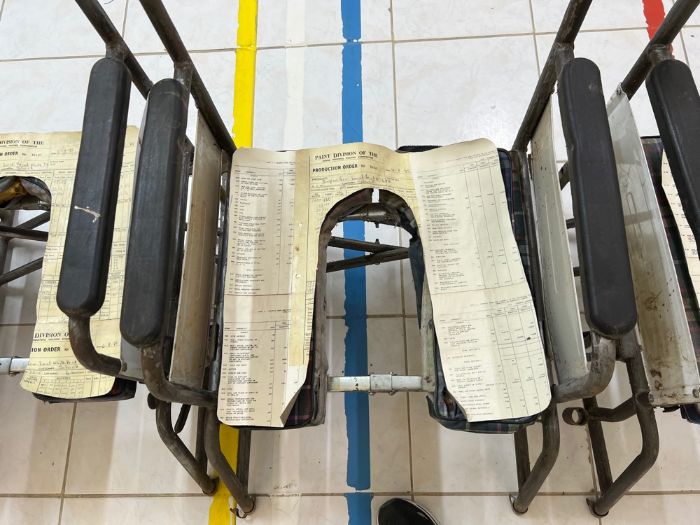 Ibrahim Mahama, Parliament of Ghosts (2023) at the Old Al Dhaid Clinic.
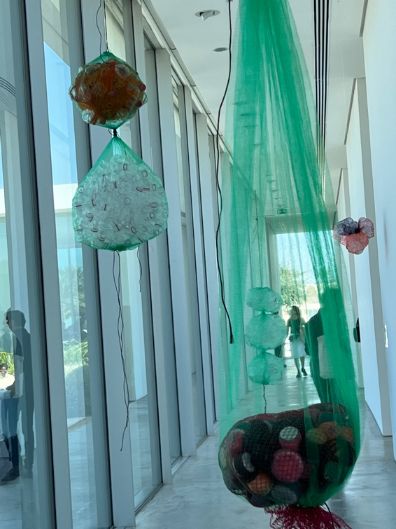 Veronica Ryan, Systems and Microbes (2022) at Al Hamriyah Studios. The 2022 Turner Prize Winner, Veronica Ryan, uses hanging assemblages made of date nets, bottle tops, plastic refuse, and other materials sourced in Sharjah.
 Kerry James Marshall, Untitled: Excavation (2022) at the Old Al Diwan Al Amiri.
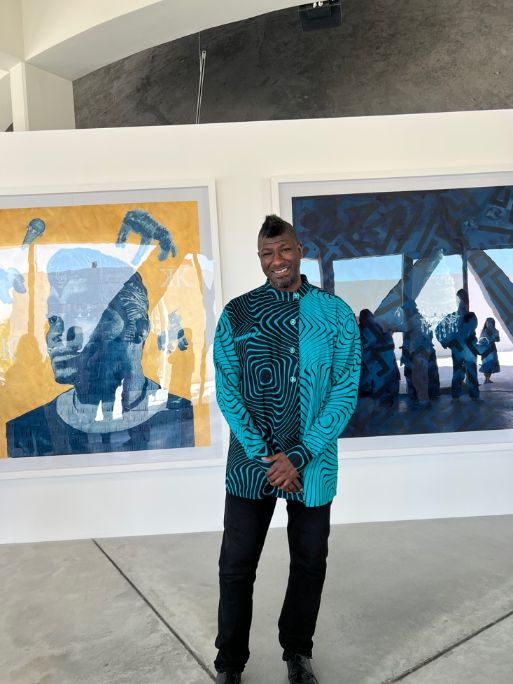 Kambui Olujimi with his work, In the Dark, We Lose Our Edges (2023) at the Flying Saucer.
Secondly, “Enwezor decentered the discursive myths of the European art canonical avant-garde, critiquing the conservatism and social detachment of its vision of modernity….” Sharjah Biennial 15 is a “transnational nexus of global civic enunciation.” Artist identifiers do not refer to the artist’s nationality except indirectly to provide context for artistic practice in the Guidebook (an essential reference tool for visitors to maximize the viewing experience). Carrie Mae Weems presents The In Between (2022-2023) that pays homage to Enwezor, a multimedia installation composed of elements to foreground the in between, a point of departure neither here or there where Enwezor sought to make cultural institutions and art canonical histories more inclusive and representative of non- western identities.
Kambui Olujimi with his work, In the Dark, We Lose Our Edges (2023) at the Flying Saucer.
Secondly, “Enwezor decentered the discursive myths of the European art canonical avant-garde, critiquing the conservatism and social detachment of its vision of modernity….” Sharjah Biennial 15 is a “transnational nexus of global civic enunciation.” Artist identifiers do not refer to the artist’s nationality except indirectly to provide context for artistic practice in the Guidebook (an essential reference tool for visitors to maximize the viewing experience). Carrie Mae Weems presents The In Between (2022-2023) that pays homage to Enwezor, a multimedia installation composed of elements to foreground the in between, a point of departure neither here or there where Enwezor sought to make cultural institutions and art canonical histories more inclusive and representative of non- western identities.
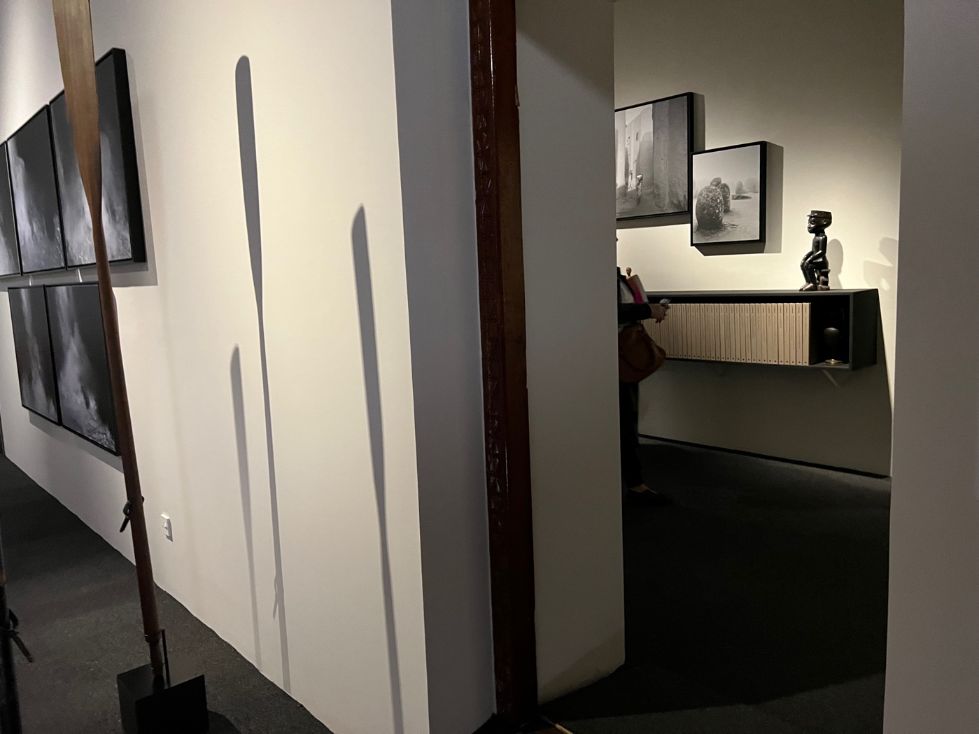 Carrie Mae Weems, The In Between (2022-2023) at Calligraphy Square.
Thinking Historically in the Present: The Notion and Meaning of Time
The phrase that is the guiding principle of the biennial — “thinking historically in the present” — was introduced by Enwezor in 2005. Al Qasimi states “he invoked the dislocation of belonging” and the “disjunction of time as the shared affective core felt across the post-colonial world. How, he asked us to imagine, do you live these disjunctions and experience these disjunctions and experience these dislocations from the inside?” This principle provides an amazing source for archival research, inspiration and creativity for the selected artists. The impact of colonial histories, global politics, immigration, incarceration, traditional narrative structures, folklore and communal practices, enable the artists through film, multimedia, painting, sculpture and performance to invite viewers to reconfigure ways to view non-canonical wisdom or understand contemporary problems like power, food trade, and climate change as caused by other than as explained by the power structure: to create narratives to interweave current political problems and turmoil with a rich historical past mythical and forgotten histories to enable both artist and viewer to search for identity and new ways of resistance, reconciliation and politics. Not surprisingly, the theme causes us and the participating artists to reflect on ancient epistemologies and time as a philosophical, historical and existential concept. Contradicting the tendency of Eurocentric historiographies of the Gulf to frame oil expeditions as the beginning of the emirate history, Al Qasimi begins her statement by referencing that “tales and allegories of Sharjah and the Gulf were historically mediated by soothsayers whose intuition served as a conduit to transmit messages from other worlds… These stories were vessels for the accretion of ancestral wisdom relayed orally from one generation and reference to Sharjah and its beginnings dating from archeological finds to 10,000 years ago… In Sharjah’s curatorial and historic models for the Sharjah Biennial 15 there is guidance with the chronotype of ‘deep time’ and the Kharareef of our ancestors.” Wangechi Mutu presents a new sculptural installation titled My Mother’s Memories, a Mound of Buried Brides (2023), a visual poem which reflects on the resilience of the women who fought for the independence of Kenya in the Mau Mau rebellion.
Carrie Mae Weems, The In Between (2022-2023) at Calligraphy Square.
Thinking Historically in the Present: The Notion and Meaning of Time
The phrase that is the guiding principle of the biennial — “thinking historically in the present” — was introduced by Enwezor in 2005. Al Qasimi states “he invoked the dislocation of belonging” and the “disjunction of time as the shared affective core felt across the post-colonial world. How, he asked us to imagine, do you live these disjunctions and experience these disjunctions and experience these dislocations from the inside?” This principle provides an amazing source for archival research, inspiration and creativity for the selected artists. The impact of colonial histories, global politics, immigration, incarceration, traditional narrative structures, folklore and communal practices, enable the artists through film, multimedia, painting, sculpture and performance to invite viewers to reconfigure ways to view non-canonical wisdom or understand contemporary problems like power, food trade, and climate change as caused by other than as explained by the power structure: to create narratives to interweave current political problems and turmoil with a rich historical past mythical and forgotten histories to enable both artist and viewer to search for identity and new ways of resistance, reconciliation and politics. Not surprisingly, the theme causes us and the participating artists to reflect on ancient epistemologies and time as a philosophical, historical and existential concept. Contradicting the tendency of Eurocentric historiographies of the Gulf to frame oil expeditions as the beginning of the emirate history, Al Qasimi begins her statement by referencing that “tales and allegories of Sharjah and the Gulf were historically mediated by soothsayers whose intuition served as a conduit to transmit messages from other worlds… These stories were vessels for the accretion of ancestral wisdom relayed orally from one generation and reference to Sharjah and its beginnings dating from archeological finds to 10,000 years ago… In Sharjah’s curatorial and historic models for the Sharjah Biennial 15 there is guidance with the chronotype of ‘deep time’ and the Kharareef of our ancestors.” Wangechi Mutu presents a new sculptural installation titled My Mother’s Memories, a Mound of Buried Brides (2023), a visual poem which reflects on the resilience of the women who fought for the independence of Kenya in the Mau Mau rebellion.
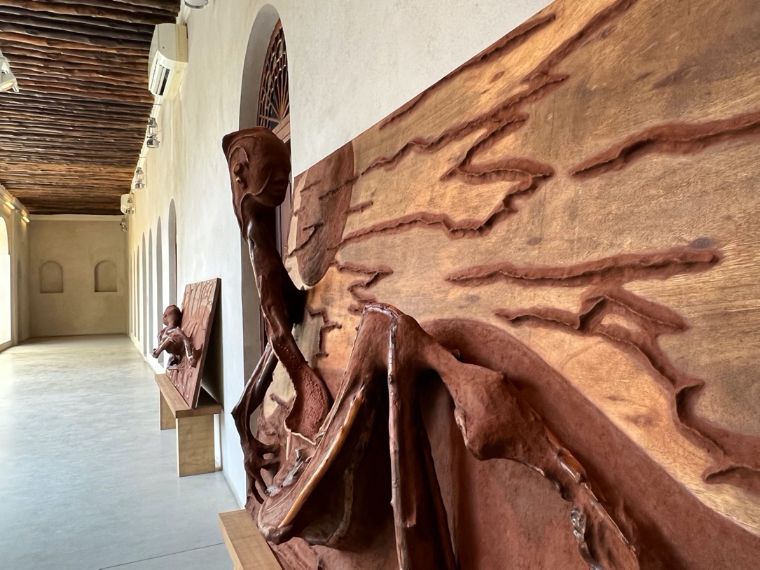
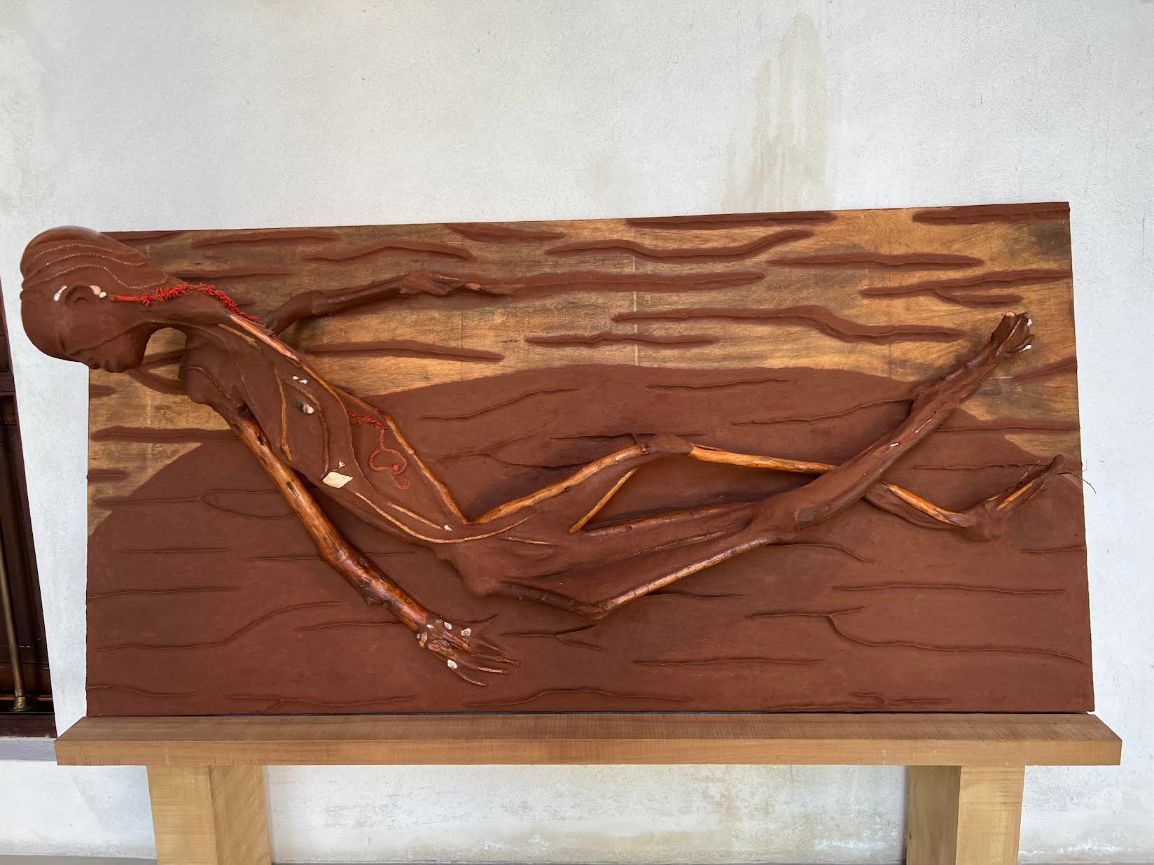 Wangechi Mutu, My Mother’s Memories, a Mound of Buried Ashes (2023) at Bait Al Serkal.
Time as history is seen in the installations and documentation of many photographers and film makers who were either direct participants in the struggles like Omar Badsha, political activist and trade union leader, who is known as one of the pioneers of anti-colonial resistance art from South Africa, and his work Once We were Warriors: Women and the Resistance in the South African Liberation Struggle (1982-1999); or witness to such struggles like Hiroji Kubuta, Magnum photographer, who documents with the rare vision of an outsider from Japan the end of segregation, the rise of the black panther Party and black power and the antiwar movements. Manthia Diawara’s capacious scholarly and creative process has made a major contribution to the field of Black and African diasporic cultural studies. He presents Angela Davis: A World of Greater Freedom (2023). Together he and Davis unpack the principle cores of Davis’s philosophy: “to deconstruct and contextualize contemporary meanings of life and ecology… to narrate new, multiple and unpredictable social realities.” Sir Isaac Julien’s practice often examines the politics of masculinity, class and race to deconstruct and reclaim black histories. Julien presents Once Again … (Statutes Never Die) (2022), taking its title from the 1954 film of Chris marker and Alan Renais Statutes Also Die (1954) on historical African art and its decline under colonialism. Originally commissioned for the 100th anniversary of the Barnes foundation, the five-channel black-and-white video installation explores the legacies of the philosopher, critic and queer cultural leader Alan Locke and African art collector Albert Barnes, whose collection inspired both Locke and the Harlem Renaissance artists. While not immediately obvious unless one spends the time with this mesmerizing five-channel installation and accompanying sculptures, Julien not only reimagines Locke’s relationship and correspondence with Barnes, but also contextualizes contemporary efforts for reparations, gesturing at the critical dialogue which can inspire such claims. Al Qasimi’s goal to build a platform that links Sharjah as a center for knowledge production to the intersectional discourses of the postcolonial constellation, while remaining grounded in collaborative methodologies and civic engagement, is advanced by presenting us such discourse and conversation as presented by Julien, given the clear focus on homosexuality and its acceptance, given the fact that Sharjah is one of the more conservative of the Emirates where prayer is regular, women are veiled and alcoholic consumption is forbidden.
Wangechi Mutu, My Mother’s Memories, a Mound of Buried Ashes (2023) at Bait Al Serkal.
Time as history is seen in the installations and documentation of many photographers and film makers who were either direct participants in the struggles like Omar Badsha, political activist and trade union leader, who is known as one of the pioneers of anti-colonial resistance art from South Africa, and his work Once We were Warriors: Women and the Resistance in the South African Liberation Struggle (1982-1999); or witness to such struggles like Hiroji Kubuta, Magnum photographer, who documents with the rare vision of an outsider from Japan the end of segregation, the rise of the black panther Party and black power and the antiwar movements. Manthia Diawara’s capacious scholarly and creative process has made a major contribution to the field of Black and African diasporic cultural studies. He presents Angela Davis: A World of Greater Freedom (2023). Together he and Davis unpack the principle cores of Davis’s philosophy: “to deconstruct and contextualize contemporary meanings of life and ecology… to narrate new, multiple and unpredictable social realities.” Sir Isaac Julien’s practice often examines the politics of masculinity, class and race to deconstruct and reclaim black histories. Julien presents Once Again … (Statutes Never Die) (2022), taking its title from the 1954 film of Chris marker and Alan Renais Statutes Also Die (1954) on historical African art and its decline under colonialism. Originally commissioned for the 100th anniversary of the Barnes foundation, the five-channel black-and-white video installation explores the legacies of the philosopher, critic and queer cultural leader Alan Locke and African art collector Albert Barnes, whose collection inspired both Locke and the Harlem Renaissance artists. While not immediately obvious unless one spends the time with this mesmerizing five-channel installation and accompanying sculptures, Julien not only reimagines Locke’s relationship and correspondence with Barnes, but also contextualizes contemporary efforts for reparations, gesturing at the critical dialogue which can inspire such claims. Al Qasimi’s goal to build a platform that links Sharjah as a center for knowledge production to the intersectional discourses of the postcolonial constellation, while remaining grounded in collaborative methodologies and civic engagement, is advanced by presenting us such discourse and conversation as presented by Julien, given the clear focus on homosexuality and its acceptance, given the fact that Sharjah is one of the more conservative of the Emirates where prayer is regular, women are veiled and alcoholic consumption is forbidden.
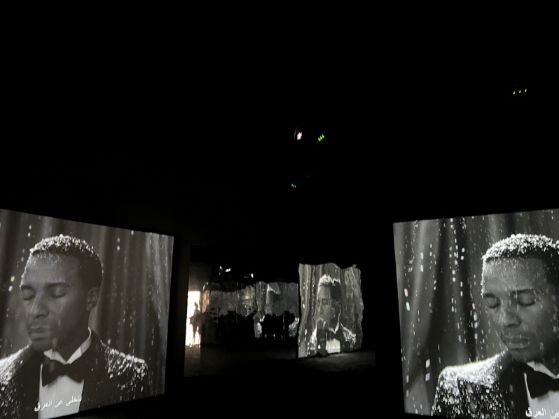
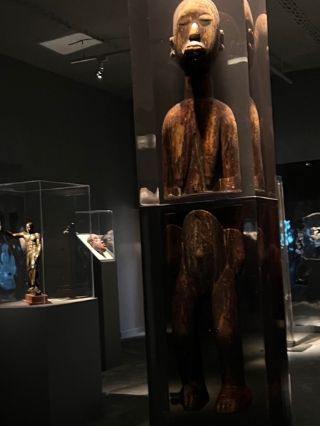
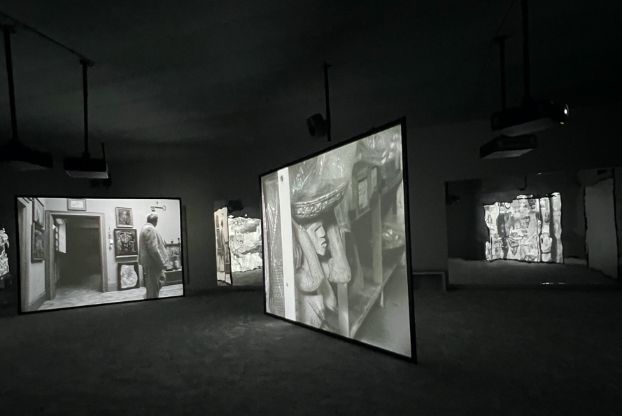 Isaac Julien, Once Again … (Statues Never Die) (2022) at Calligraphy Square.
Coco Fusco, an interdisciplinary artist and writer, engages with themes of power, race and the sociopolitical ramifications of her Cuban exile. She has also studied an era of Cuba’s history, characterized by the persecution of those deemed “ ideologically divergent..” The term, introduced by Raul Castro in the 1970’s, extended to all whose personal and political identities permitted them from submitting the revolutionary, effectively criminalizing dissent.” The Eternal Night (La Noche Eternal) (2022) is a poetic feature length black and white film which reactivates and reimagines the political conflicts precipitated by the modern nation-building process in Cuba is based on the life of writer and former political prisoner Nestor Diaz de Villegas. Researched for over two years and based on archival footage mixed with live performances, the film follows the lives of a poet, a young Evangelical man and a seasoned stage actor charged with an assassination attempt on Castro. Guided by the actor, the three endeavor to survive incarceration with wit, strength of will and shared love of cinema.”
Poetry, art, theater, and connection to the narratives of a time remembered of the richness of Haitian cultural and intellectual production, spiritual practice as a means of survival and resistance in a world of chaos and irrationality caused by the natural and political tragedy of Haiti is the message of the ensemble The Living and the Dead. Composed of ten artists, performer, and poets, from Haiti, France and the United Kingdom. The Wake (2021) an immersive and powerful three channel video that revolves around the charged atmosphere of a night filled with demonstrations, earthquakes and the fire of struggle and pain, rebirth and chaos. “ Amid these flames, a community dreams of flight, travel, and alliances among diasporas, invoking the restlessness that haunt our electronic realms. “We as viewers, share the pain and trauma immered in the hope that the goal to create a narrative based on the weaving of the insane present with the mythical, colorful and often forgotten histories of the past can lead to rebirth.
Image follows
Time as memory and lived history, including its impact on those who have suffered systematic abuse and institutional complicity fuels the performances and photographic art work of Vivan Sundaram, a leading artist of New Delhi’s intellectual and artistic community for six decades. Sundaram’s photography-based project, Six Stations of a Life Pursued (2022), signifies “a journey with periodic halts that release pain, regain trust, behold beauty, recall horror and discard memory-a life pursued. History acquires an allegorical mode yet the narrative rewinds history.”
Isaac Julien, Once Again … (Statues Never Die) (2022) at Calligraphy Square.
Coco Fusco, an interdisciplinary artist and writer, engages with themes of power, race and the sociopolitical ramifications of her Cuban exile. She has also studied an era of Cuba’s history, characterized by the persecution of those deemed “ ideologically divergent..” The term, introduced by Raul Castro in the 1970’s, extended to all whose personal and political identities permitted them from submitting the revolutionary, effectively criminalizing dissent.” The Eternal Night (La Noche Eternal) (2022) is a poetic feature length black and white film which reactivates and reimagines the political conflicts precipitated by the modern nation-building process in Cuba is based on the life of writer and former political prisoner Nestor Diaz de Villegas. Researched for over two years and based on archival footage mixed with live performances, the film follows the lives of a poet, a young Evangelical man and a seasoned stage actor charged with an assassination attempt on Castro. Guided by the actor, the three endeavor to survive incarceration with wit, strength of will and shared love of cinema.”
Poetry, art, theater, and connection to the narratives of a time remembered of the richness of Haitian cultural and intellectual production, spiritual practice as a means of survival and resistance in a world of chaos and irrationality caused by the natural and political tragedy of Haiti is the message of the ensemble The Living and the Dead. Composed of ten artists, performer, and poets, from Haiti, France and the United Kingdom. The Wake (2021) an immersive and powerful three channel video that revolves around the charged atmosphere of a night filled with demonstrations, earthquakes and the fire of struggle and pain, rebirth and chaos. “ Amid these flames, a community dreams of flight, travel, and alliances among diasporas, invoking the restlessness that haunt our electronic realms. “We as viewers, share the pain and trauma immered in the hope that the goal to create a narrative based on the weaving of the insane present with the mythical, colorful and often forgotten histories of the past can lead to rebirth.
Image follows
Time as memory and lived history, including its impact on those who have suffered systematic abuse and institutional complicity fuels the performances and photographic art work of Vivan Sundaram, a leading artist of New Delhi’s intellectual and artistic community for six decades. Sundaram’s photography-based project, Six Stations of a Life Pursued (2022), signifies “a journey with periodic halts that release pain, regain trust, behold beauty, recall horror and discard memory-a life pursued. History acquires an allegorical mode yet the narrative rewinds history.”
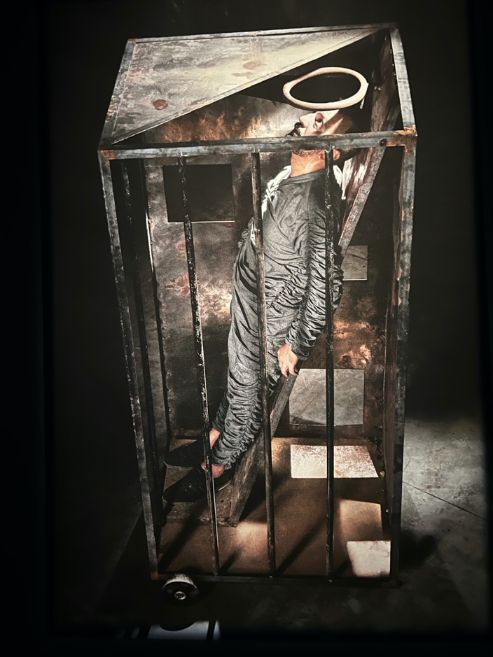
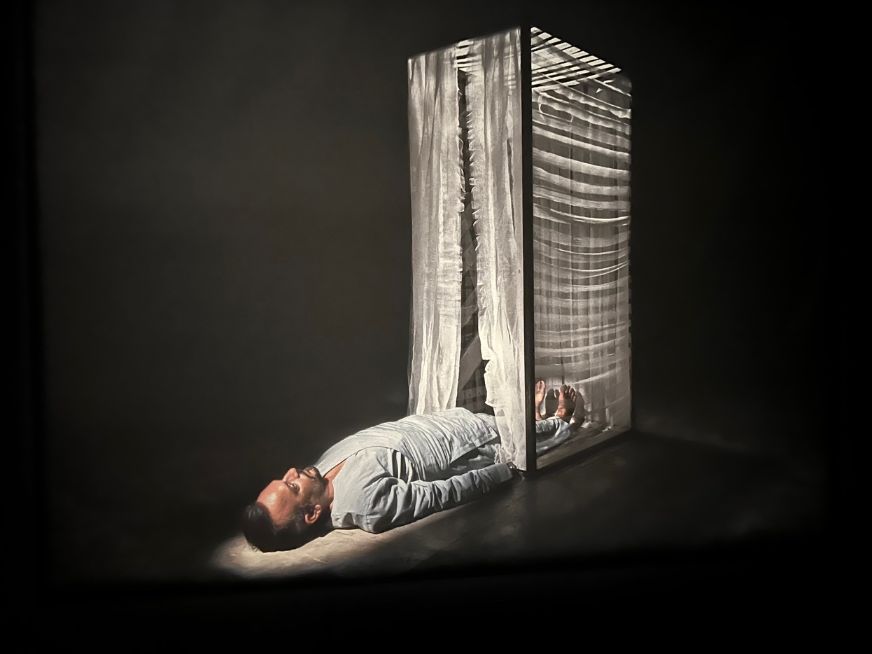 Vivan Sundaram, Six Stations of a Life Pursued (2022) at Al Mureijah Square.
In Parliament of Objects (2023), Ibrahim Mahama creates as assemblage of found objects, including abandoned seats, desks, handwritten textbooks, and combines them with Polaroid images of institutional buildings in Ghana. Together, these objects create a timeline of freedom, “a country, and its people, claiming the right to their independence from the British colonizer—a journey that came to an end 65 years ago.”
Time as an existential construct created by a society and its durational measurement relative to traditional beliefs, nature and the universe is dramatically presented in the five-screen multichannel mesmerizing installation by Sir John Akomfrah. The brilliance and sheer poetry of Akomfrah’s practice in pushing the boundaries of the cinematic form to explore radical ways of understanding history is taken literally and figuratively to new levels in the new film commissioned for Sharjah 15, Arcadia (2023). Arcadia “tackles the ecological implications of settler colonialism, extractive capitalism and the extinction of microorganisms…. The artist extent the oral as well as representational history of various indigenous cultures to create a multiscreen installation that combines events, memories, landscapes and characters in the form of a mixed media collage. The result is an immersive experience of a less human centric view of postcolonial reality that brings to the floor the often-destructive relationship between humans and inorganic matters in an already fragile ecology.” If there is one work that could be said to embody the themes of memory, identity, postcolonialism, temporality and the politics of aesthetics that pervade so many of the eloquent artistic statements in their manifest forms, media and materials, it is for me, Arcadia. I am thrilled to learn that Akomfrah will represent the UK in Venice in 2024.
Vivan Sundaram, Six Stations of a Life Pursued (2022) at Al Mureijah Square.
In Parliament of Objects (2023), Ibrahim Mahama creates as assemblage of found objects, including abandoned seats, desks, handwritten textbooks, and combines them with Polaroid images of institutional buildings in Ghana. Together, these objects create a timeline of freedom, “a country, and its people, claiming the right to their independence from the British colonizer—a journey that came to an end 65 years ago.”
Time as an existential construct created by a society and its durational measurement relative to traditional beliefs, nature and the universe is dramatically presented in the five-screen multichannel mesmerizing installation by Sir John Akomfrah. The brilliance and sheer poetry of Akomfrah’s practice in pushing the boundaries of the cinematic form to explore radical ways of understanding history is taken literally and figuratively to new levels in the new film commissioned for Sharjah 15, Arcadia (2023). Arcadia “tackles the ecological implications of settler colonialism, extractive capitalism and the extinction of microorganisms…. The artist extent the oral as well as representational history of various indigenous cultures to create a multiscreen installation that combines events, memories, landscapes and characters in the form of a mixed media collage. The result is an immersive experience of a less human centric view of postcolonial reality that brings to the floor the often-destructive relationship between humans and inorganic matters in an already fragile ecology.” If there is one work that could be said to embody the themes of memory, identity, postcolonialism, temporality and the politics of aesthetics that pervade so many of the eloquent artistic statements in their manifest forms, media and materials, it is for me, Arcadia. I am thrilled to learn that Akomfrah will represent the UK in Venice in 2024.
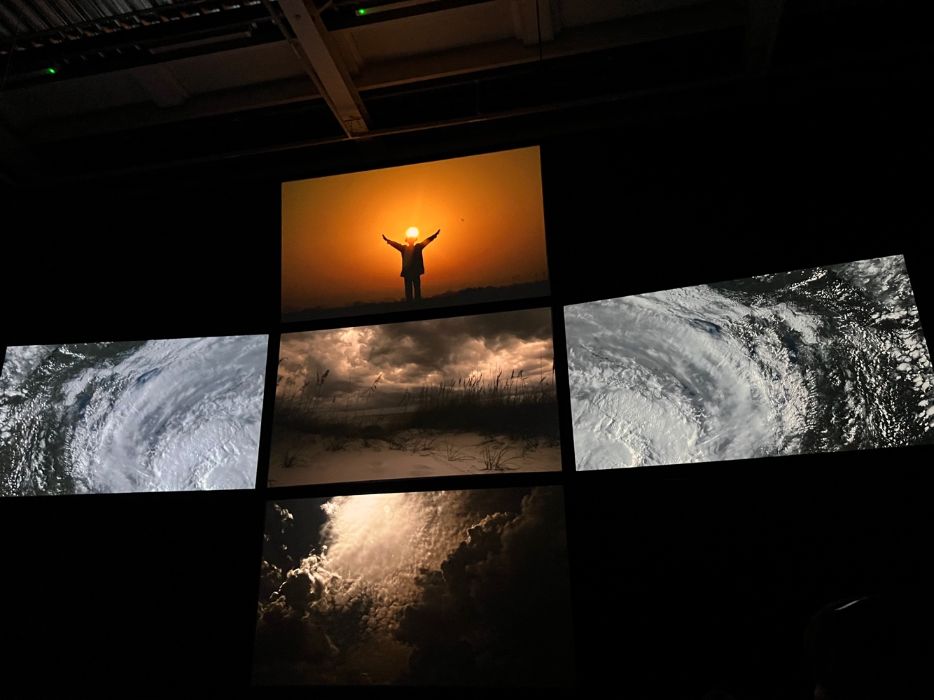
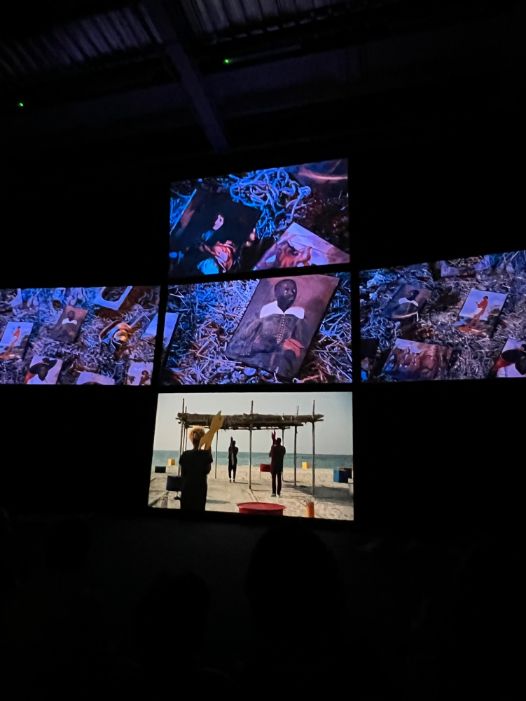 John Akomfrah, Arcadia (2023) at Al Mureijah Square.
Environmental Historical Memory, Diasporic Labor, Food, Shelter, Power and Extraction of Resources
Not surprisingly many artists draw on indigenous epistemologies to examine the future of shared resources. Others investigate the meaning of food in socio-political and cultural context on a local and global scale. Elia Nurvista reflects on concepts within food discourse related to “globalization, material extraction, exploitation and exotification.” Mirna Bamieh’s work in the Old Al Jubail Vegetable Market, Sour Things (2023), uses fermentation “as a metaphor for zooming into micro-words of encapsulated multitudes in order to look at life, cities, people, relationships and culture.” Joiri Minyaya’s work investigates colonial hierarchies particularly in reference to the repetitive fixation of the global north on the tropics as an “abundant land and society poised for extraction and servitude, visually linking ethnobotany and exoticism, tropical identity and its commodification” (ie: Gaugin).
John Akomfrah, Arcadia (2023) at Al Mureijah Square.
Environmental Historical Memory, Diasporic Labor, Food, Shelter, Power and Extraction of Resources
Not surprisingly many artists draw on indigenous epistemologies to examine the future of shared resources. Others investigate the meaning of food in socio-political and cultural context on a local and global scale. Elia Nurvista reflects on concepts within food discourse related to “globalization, material extraction, exploitation and exotification.” Mirna Bamieh’s work in the Old Al Jubail Vegetable Market, Sour Things (2023), uses fermentation “as a metaphor for zooming into micro-words of encapsulated multitudes in order to look at life, cities, people, relationships and culture.” Joiri Minyaya’s work investigates colonial hierarchies particularly in reference to the repetitive fixation of the global north on the tropics as an “abundant land and society poised for extraction and servitude, visually linking ethnobotany and exoticism, tropical identity and its commodification” (ie: Gaugin).
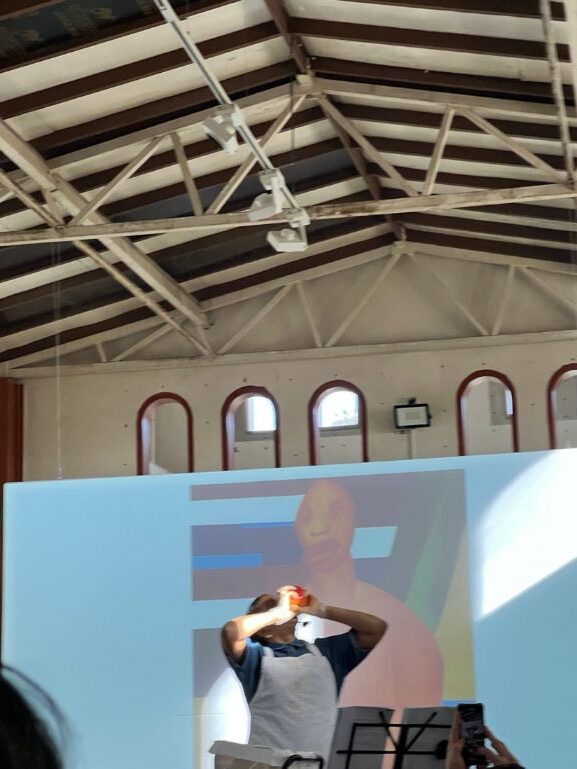 Joiri Minaya Performance in Old Al Jubail Vegetable Market.
Mandla is a queer and agender writer performer who presents a video installation taken from As British as A watermelon (2019), a performance examining frameworks of systemic racism through the bounds of a structure of fluorescent lights and watermelons.
Joiri Minaya Performance in Old Al Jubail Vegetable Market.
Mandla is a queer and agender writer performer who presents a video installation taken from As British as A watermelon (2019), a performance examining frameworks of systemic racism through the bounds of a structure of fluorescent lights and watermelons.
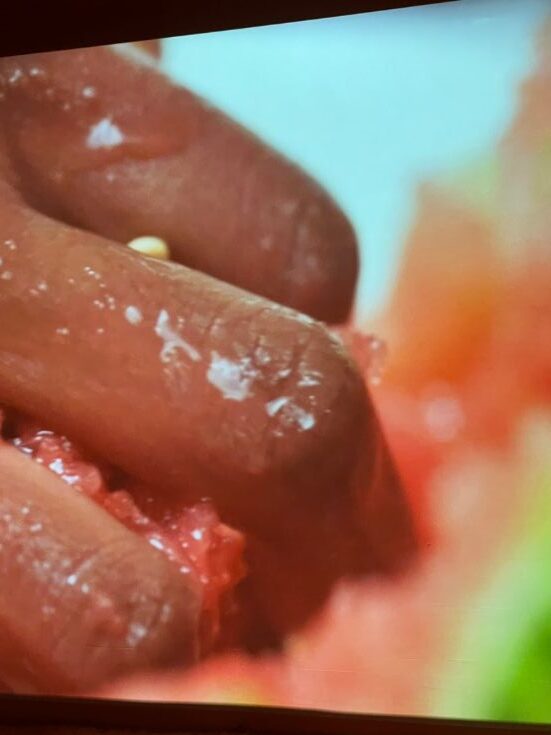
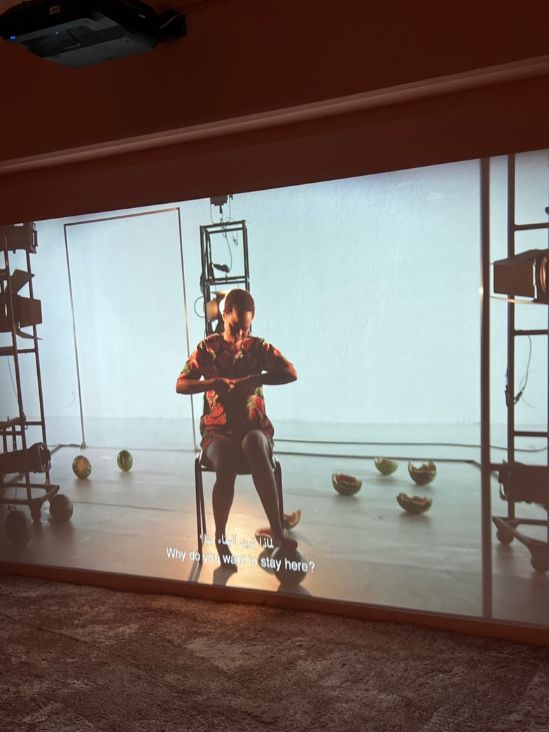 Mandla, As British as a Watermelon (2019) at the Africa Institute.
Carolina Caycedo’s Agua Pesada / Alma Althaquil [Heavy Water] (2023) is inspired by the aludeles, bottomless-pot furnaces of the Almadén mercury mines in Spain, the largest and most prolific mercury concentration in the world. The work is intended to “contribute strength of environmental historical memory considers fundamental force in defense of human and nonhuman entities against destructive violence.
Mandla, As British as a Watermelon (2019) at the Africa Institute.
Carolina Caycedo’s Agua Pesada / Alma Althaquil [Heavy Water] (2023) is inspired by the aludeles, bottomless-pot furnaces of the Almadén mercury mines in Spain, the largest and most prolific mercury concentration in the world. The work is intended to “contribute strength of environmental historical memory considers fundamental force in defense of human and nonhuman entities against destructive violence.
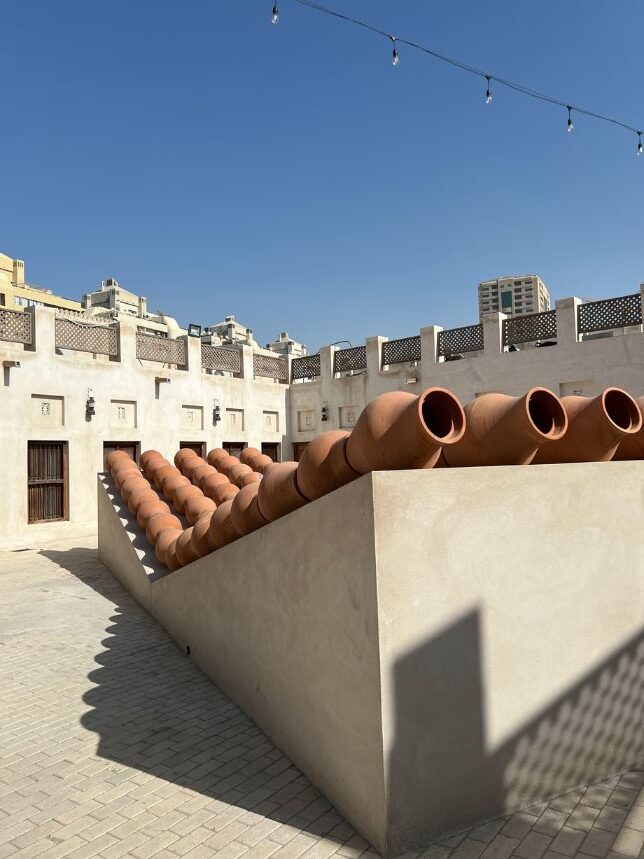 Carolina Caycedo, Agua Pesada / Alma Althaquil [Heavy Water] (2023) on view at Calligraphy Square.
Felix Shumba explores social trauma in an attempt to interrogate ways in which history is constructed. Researching in the historic archives of his native Zimbabwe, he presents Ruwa River (2022) and Nocturnal Body (2022) revealing from his research the lethality of the government’s suppression of the insurgency through the use of chemical weapons. For Shumba, the materiality of charcoal parallels the suffocation of black lives.
Carolina Caycedo, Agua Pesada / Alma Althaquil [Heavy Water] (2023) on view at Calligraphy Square.
Felix Shumba explores social trauma in an attempt to interrogate ways in which history is constructed. Researching in the historic archives of his native Zimbabwe, he presents Ruwa River (2022) and Nocturnal Body (2022) revealing from his research the lethality of the government’s suppression of the insurgency through the use of chemical weapons. For Shumba, the materiality of charcoal parallels the suffocation of black lives.
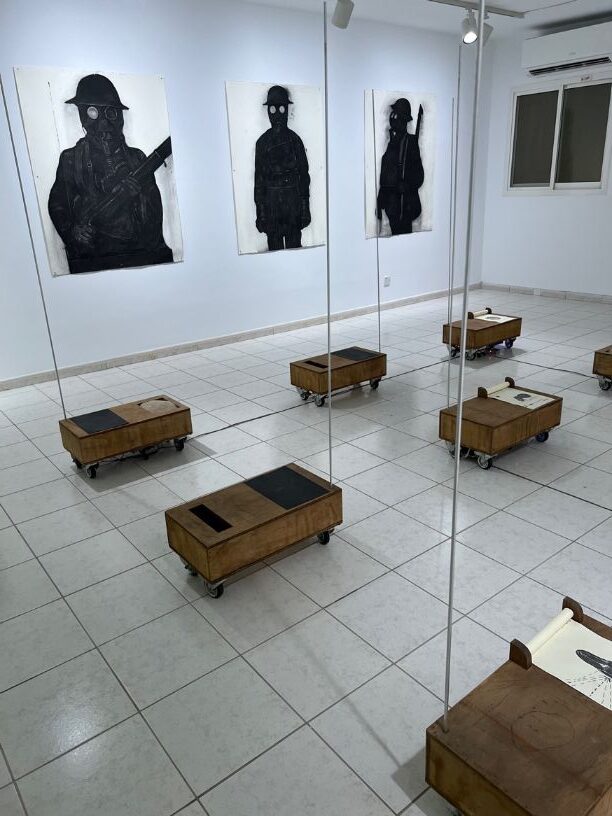 Felix Shumba, Ruwa River (2022) and Nocturnal Body (2022) at the Old Al Dhaid Clinic.
Nari Ward presents Duty Colossus (2023), a site-specific installation in a former fish factory composed of two elements, a dhow and a Jamaican fish trap. For Ward, one important element is the space in between. Even more important, Ward told me is the fish trap as a metaphor for time. The portal functions through an interplay of seduction and entrapment. With reference to time, Ward quotes from Jimmie Durham: “we live with our experiences always in the past as echo and reverberation of the present.”
Felix Shumba, Ruwa River (2022) and Nocturnal Body (2022) at the Old Al Dhaid Clinic.
Nari Ward presents Duty Colossus (2023), a site-specific installation in a former fish factory composed of two elements, a dhow and a Jamaican fish trap. For Ward, one important element is the space in between. Even more important, Ward told me is the fish trap as a metaphor for time. The portal functions through an interplay of seduction and entrapment. With reference to time, Ward quotes from Jimmie Durham: “we live with our experiences always in the past as echo and reverberation of the present.”
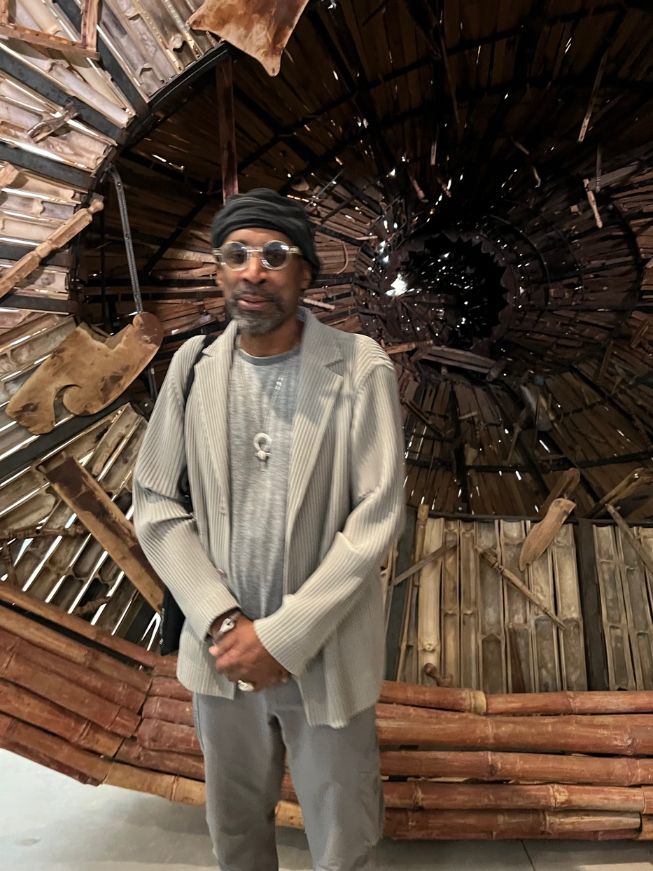 Artist Nari Ward in front of his work, Duty Colossus (2023) at Kalba Ice Factory.
Doris Salcedo presents Uprooted (2020-2022), 804 dead trees that are sculpted and assembled to depict a house. “Structurally uninhabitable, the work symbolizes the refugee’s predicament—a seemingly permanent state of impermanence… attributing the
cause of this forced movement of people most fundamentally to the capitalist destruction of the environment, Salcedo manipulates organic material into monumental sardonic artefact.”
Artist Nari Ward in front of his work, Duty Colossus (2023) at Kalba Ice Factory.
Doris Salcedo presents Uprooted (2020-2022), 804 dead trees that are sculpted and assembled to depict a house. “Structurally uninhabitable, the work symbolizes the refugee’s predicament—a seemingly permanent state of impermanence… attributing the
cause of this forced movement of people most fundamentally to the capitalist destruction of the environment, Salcedo manipulates organic material into monumental sardonic artefact.”
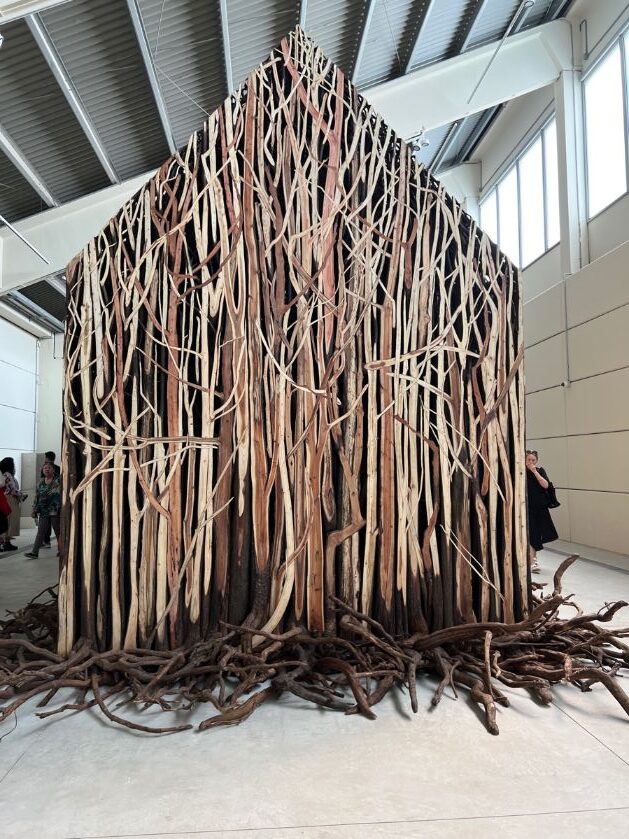
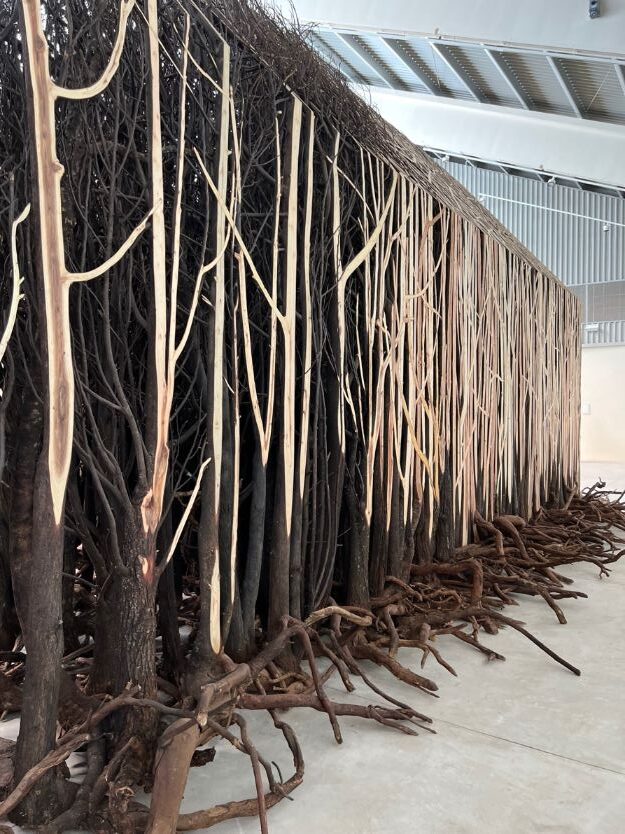 Doris Salcedo, Uprooted (2020-2022) at Kalba Ice Factory.
Maria Magdalena Campos-Pons “grapples with the coordinates of diasporic identity formation: migration, displacement, collective memory, spirituality and gender.” In her work, Murmullo Familiar [Family Whisper] (2021-2023), “alongside beds of red sand collected from Mleiha, a desert in Sharjah that is reminiscent of the soil in Mantazas, Cuba, a set of glass stools, cast from one passed down by Campos-Pons’ family across generations, operate as metaphors of absence, representing those lost or unaccounted for by the ruptures of Afro-Cuban history …” Campos-Pons will have a solo exhibition at the Brooklyn Museum at September 2023.
Doris Salcedo, Uprooted (2020-2022) at Kalba Ice Factory.
Maria Magdalena Campos-Pons “grapples with the coordinates of diasporic identity formation: migration, displacement, collective memory, spirituality and gender.” In her work, Murmullo Familiar [Family Whisper] (2021-2023), “alongside beds of red sand collected from Mleiha, a desert in Sharjah that is reminiscent of the soil in Mantazas, Cuba, a set of glass stools, cast from one passed down by Campos-Pons’ family across generations, operate as metaphors of absence, representing those lost or unaccounted for by the ruptures of Afro-Cuban history …” Campos-Pons will have a solo exhibition at the Brooklyn Museum at September 2023.
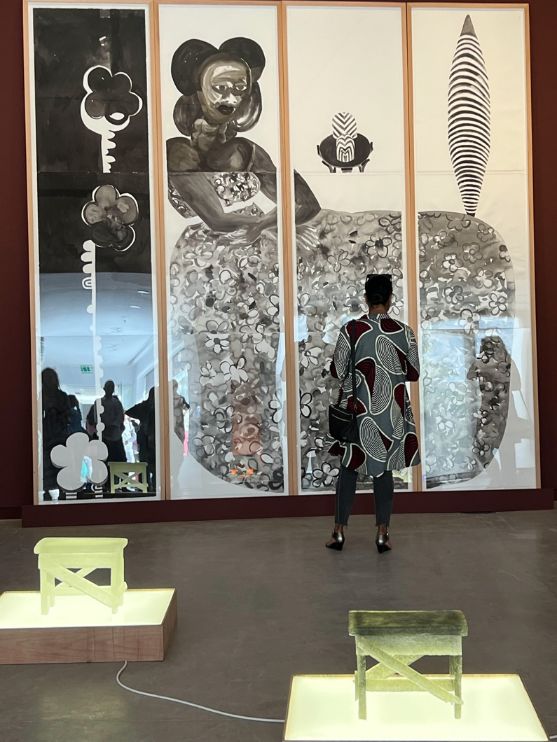 Maria Magdalena Campos-Pons, Murmullo Familiar [Family Whisper] (2021-2023) at Al Mureijah Square.
Rachid Hedli’s performance of Gueles Noires (2016), a French term used as slang for soot covered miners is a brilliant work of choreography superbly executed by his company Cie Niya, composed of a composer and performers, sons and grandsons of immigrant miners from the French Pas de Calais region. The atmospheric dance blends narrative and hip hop elements with breaking and popping movements to emulate the rhythm of hard labor set to a soundtrack of heavy machinery the piece pays tribute to Hedli’s father who died of lung cancer.
Tania El Khoury is a live performance artist. Her work is drawn from the political realities of the Lebanese Civil war and its aftermath. I attended El Khoury’s performance The Search for Power (2018), limited to an investigation around a dinner table for thirty people inviting us to track her research into power figures in Lebanon which interfered with her wedding celebration at which we are recreating the investigation and experience. During the Biennial, “an audio guide helps audiences navigate the dense archives amassed during El Khoury’s … transnational research, locating electricity at the intersection between colonial legacies, political and economic hierarchies and everyday acts of resistance, survival and sabotage.”
Maria Magdalena Campos-Pons, Murmullo Familiar [Family Whisper] (2021-2023) at Al Mureijah Square.
Rachid Hedli’s performance of Gueles Noires (2016), a French term used as slang for soot covered miners is a brilliant work of choreography superbly executed by his company Cie Niya, composed of a composer and performers, sons and grandsons of immigrant miners from the French Pas de Calais region. The atmospheric dance blends narrative and hip hop elements with breaking and popping movements to emulate the rhythm of hard labor set to a soundtrack of heavy machinery the piece pays tribute to Hedli’s father who died of lung cancer.
Tania El Khoury is a live performance artist. Her work is drawn from the political realities of the Lebanese Civil war and its aftermath. I attended El Khoury’s performance The Search for Power (2018), limited to an investigation around a dinner table for thirty people inviting us to track her research into power figures in Lebanon which interfered with her wedding celebration at which we are recreating the investigation and experience. During the Biennial, “an audio guide helps audiences navigate the dense archives amassed during El Khoury’s … transnational research, locating electricity at the intersection between colonial legacies, political and economic hierarchies and everyday acts of resistance, survival and sabotage.”
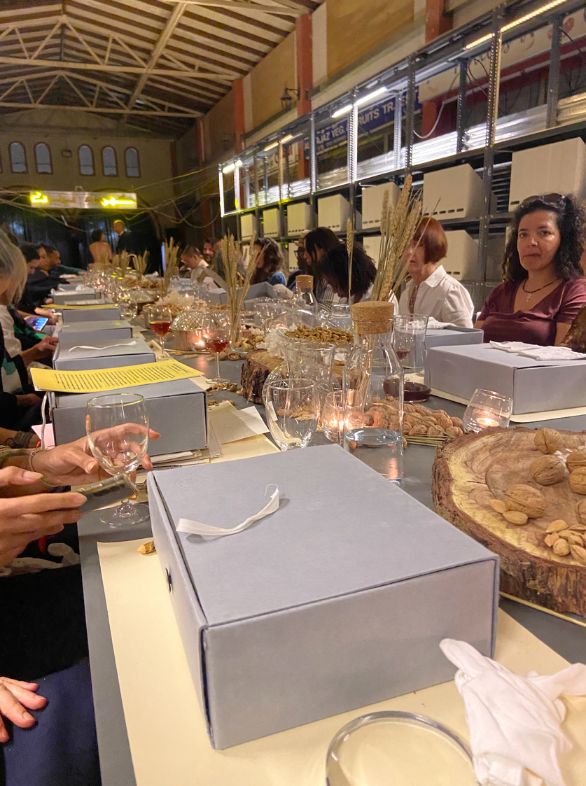
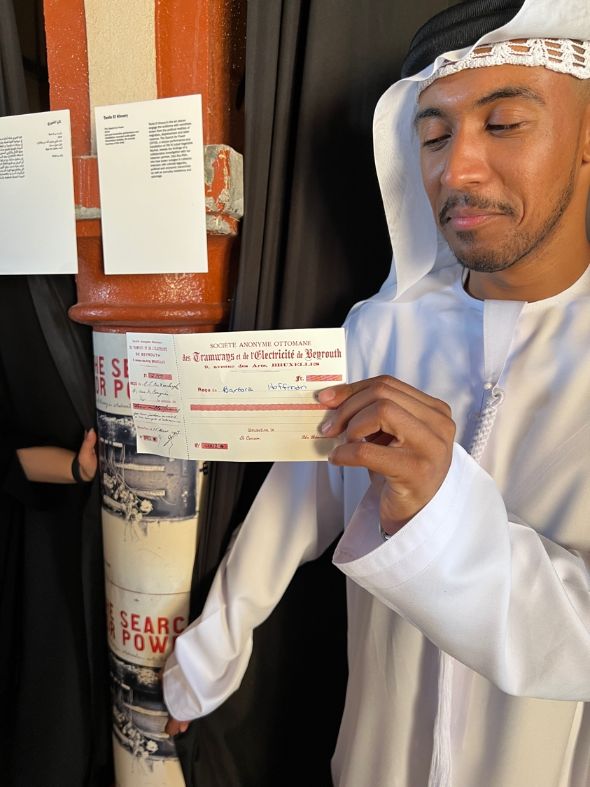 Tania El Khoury, The Search for Power (2018) at the Old Jubail Vegetable Market.
Each Biennale has its own character and traditions as each varies within its own paradigm from biennial to biennial. From what I have heard of attendees of the past, Sharjah 15 is at the pinnacle, benefitting from the collective wisdom and experience of the past. One must acknowledge the stunning curatorial success of Hoor Al Qasimi in both the selection of artists and the installation of the works in each exhibition, including the selection of sites. Each artist is represented by multiple works and located in conversation with adjacent artists. While there is a denial of a single curatorial voice, the El Quasim’s decades of experience is reflected in this important edition of the Sharjah Biennial. Notwithstanding this singular curatorial excellence, the spirit of being guided by one another, another stated aim, is achieved, “by our ever evolving cross cultural solidarity.”
A Practical Guide to the Sharjah Biennial 15: Thinking Historically in the Present
Recommended Artists****
The Sharjah Art Museum
There are numerous retrospective historical photographs, indigenous artists, in addition to numerous other excellent creations and works by known and some lesser-known artists. Anybody visiting the museum should carefully choose, in accordance to the Sharjah Biennial Guidebook, to their personal taste.
Bait Al Serkal
Wangechi Mutu
Helina Metaferia
Manthia Diawara
David Hammons
Hassan Hajjaj
Bank Street Building
Tania El Khoury
Lee Kai Chung
Calligraphy Square
Carrie Mae Weems
Isaac Julien
Mithu Sen
Carolina Caycedo
Al Mureijah Square
Mona Hatoum
Maria Magdalena Campos-Pons
Vivan Sundaram
John Akomfrah
Hajra Waheed***
Bouchra Khalili***
Old Al Jubail Vegetable Market
Tania El Khoury
Elia Nurvista
Mirna Bamieh
Joiri Minaya
Khalid Bin Mohammed School (The Africa Institute)
The Living and the Dead Ensemble
mandla
The Flying Saucer
Kambui Olujimi
Al Hamriyah Studios
Mary Sibande
Veronica Ryan
Hank Willis Thomas
Nabil El Makhloufi
Old Al Diwan Al Amiri
Kerry James Marshall
Yinka Shonibare
Joiri Minaya
Barbara Walker
Old Al Dhaid Clinic
Cao Fei
Felix Shumba
Laura Huertas Millán
Ibrahim Mahama
Rehab Eldalil
Pushpakanthan Pakkiyarajah
Kalba Ice Factory
Nari Ward
Doris Salcedo***
Khorfakkan Art Centre
Coco Fusco
Theaster Gates
Hotels
The Chedi Al Bait Sharjah
Sheraton Sharjah Beach Resort & Spa
Coral Beach Resort Sharjah
Food
The Saturday Night Taste of Arab Buffet is Extraordinary!
Tania El Khoury, The Search for Power (2018) at the Old Jubail Vegetable Market.
Each Biennale has its own character and traditions as each varies within its own paradigm from biennial to biennial. From what I have heard of attendees of the past, Sharjah 15 is at the pinnacle, benefitting from the collective wisdom and experience of the past. One must acknowledge the stunning curatorial success of Hoor Al Qasimi in both the selection of artists and the installation of the works in each exhibition, including the selection of sites. Each artist is represented by multiple works and located in conversation with adjacent artists. While there is a denial of a single curatorial voice, the El Quasim’s decades of experience is reflected in this important edition of the Sharjah Biennial. Notwithstanding this singular curatorial excellence, the spirit of being guided by one another, another stated aim, is achieved, “by our ever evolving cross cultural solidarity.”
A Practical Guide to the Sharjah Biennial 15: Thinking Historically in the Present
Recommended Artists****
The Sharjah Art Museum
There are numerous retrospective historical photographs, indigenous artists, in addition to numerous other excellent creations and works by known and some lesser-known artists. Anybody visiting the museum should carefully choose, in accordance to the Sharjah Biennial Guidebook, to their personal taste.
Bait Al Serkal
Wangechi Mutu
Helina Metaferia
Manthia Diawara
David Hammons
Hassan Hajjaj
Bank Street Building
Tania El Khoury
Lee Kai Chung
Calligraphy Square
Carrie Mae Weems
Isaac Julien
Mithu Sen
Carolina Caycedo
Al Mureijah Square
Mona Hatoum
Maria Magdalena Campos-Pons
Vivan Sundaram
John Akomfrah
Hajra Waheed***
Bouchra Khalili***
Old Al Jubail Vegetable Market
Tania El Khoury
Elia Nurvista
Mirna Bamieh
Joiri Minaya
Khalid Bin Mohammed School (The Africa Institute)
The Living and the Dead Ensemble
mandla
The Flying Saucer
Kambui Olujimi
Al Hamriyah Studios
Mary Sibande
Veronica Ryan
Hank Willis Thomas
Nabil El Makhloufi
Old Al Diwan Al Amiri
Kerry James Marshall
Yinka Shonibare
Joiri Minaya
Barbara Walker
Old Al Dhaid Clinic
Cao Fei
Felix Shumba
Laura Huertas Millán
Ibrahim Mahama
Rehab Eldalil
Pushpakanthan Pakkiyarajah
Kalba Ice Factory
Nari Ward
Doris Salcedo***
Khorfakkan Art Centre
Coco Fusco
Theaster Gates
Hotels
The Chedi Al Bait Sharjah
Sheraton Sharjah Beach Resort & Spa
Coral Beach Resort Sharjah
Food
The Saturday Night Taste of Arab Buffet is Extraordinary!
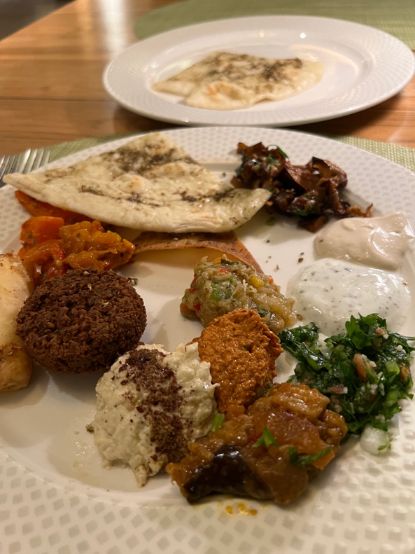
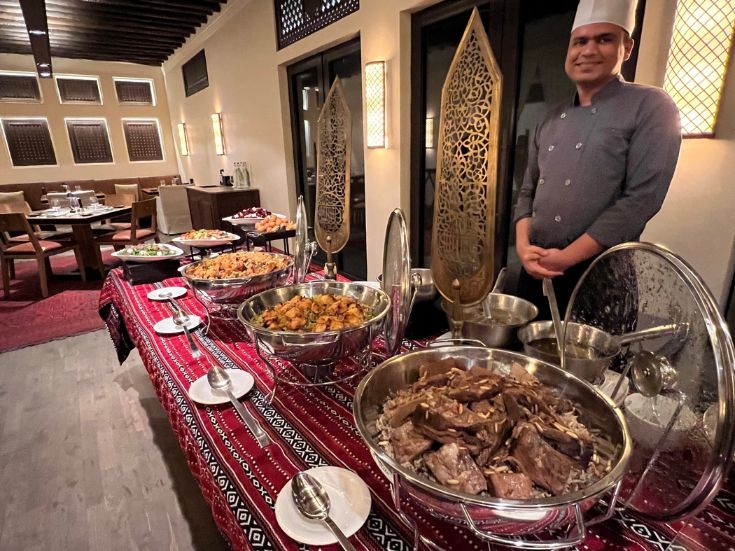
 * Barbara T. Hoffman is a preeminent international art lawyer with an undergraduate degree in art history. She has been a passionate follower of the contemporary art scene for years and a regular attendee at the Venice Biennale, Documenta, and other international art events since the early 1980’s. She writes frequently on law, art and politics for a variety of publications and is a member of the International Association of Art Critics. She serves on the Board of Performa, the Visual Performance Biennale, founder State Volunteer Lawyers for the Arts and is on MoMA's Contemporary Arts Council and Black Arts Council. She serves on the board of several artist endowed foundations and advises museums and artist foundations on issues of governance, including board development and conflict of interest and intellectual property. www.hoffmanlawfirm.org.
** Quotes included in the article, unless otherwise stated by the author, are taken from the Guidebook to the Sharjah Biennial 15: Thinking Historically in the Present.
***Artists who received the Sharjah Biennial Prize at Sharjah Biennial 15: Thinking Historically in the Present.
*** This by no means reflects artists not included in the list. Notwithstanding, the author dedicated only five days to viewing the Sharjah Biennial and Inevitably some artists may have been overlooked. It is a matter of time. I would return in a minute for another experience of the Historical Present.]]>
* Barbara T. Hoffman is a preeminent international art lawyer with an undergraduate degree in art history. She has been a passionate follower of the contemporary art scene for years and a regular attendee at the Venice Biennale, Documenta, and other international art events since the early 1980’s. She writes frequently on law, art and politics for a variety of publications and is a member of the International Association of Art Critics. She serves on the Board of Performa, the Visual Performance Biennale, founder State Volunteer Lawyers for the Arts and is on MoMA's Contemporary Arts Council and Black Arts Council. She serves on the board of several artist endowed foundations and advises museums and artist foundations on issues of governance, including board development and conflict of interest and intellectual property. www.hoffmanlawfirm.org.
** Quotes included in the article, unless otherwise stated by the author, are taken from the Guidebook to the Sharjah Biennial 15: Thinking Historically in the Present.
***Artists who received the Sharjah Biennial Prize at Sharjah Biennial 15: Thinking Historically in the Present.
*** This by no means reflects artists not included in the list. Notwithstanding, the author dedicated only five days to viewing the Sharjah Biennial and Inevitably some artists may have been overlooked. It is a matter of time. I would return in a minute for another experience of the Historical Present.]]>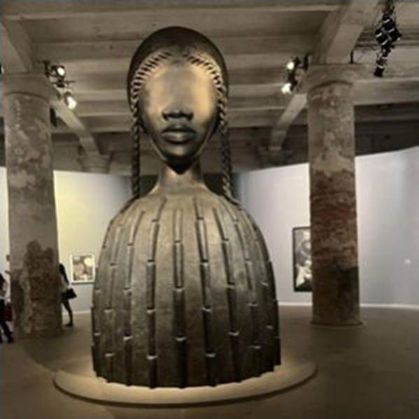 Simon Leigh, USA (2022). The entrance to the Milk of Dreams Exhibition at the Arsenal.
 Central Pavilion. Barbara Kruger, Untitled. Beginning, Middle End.
 Homage to Belkis Ayon. La consagracion, Havana, Cuba. Arsenales.
documenta fifteen
Founded in 1955 in Kassel, Germany, documenta is a quinquennial international art exhibition that carries heavy intellectual weight in the art world, customarily programmed for a duration of 100 days in venues throughout Kassel. While held in high regard among artists, curators and institutional directors, perhaps less so among collectors and dealers given its often more academic, intellectual and less market-friendly nature. Normally, the artistic director is a well-recognized international curator: Adam Szymczyk (14); Catherine David,Pompidou Paris 1997 (10); and Okwui Enwezor 2002 (11).
Breaking with this tradition, documenta fifteen poses a radical artistic response to the world’s crisis, at first encounter, a seismic shift in envisioning not only the role of the site and the exhibition, but the very role of the artist and the systems of art production. documenta fifteen is not theme based. It is about process and practice: how do people create the material and immaterial infrastructure they need to nurture and sustain themselves and their ecosystems?
documenta fifteen takes place from June 18 to September 25, 2022, under the Artistic Direction of ruangrupa at 32 venues in Kassel, Germany. The Jakarta-based artist collective has built the foundation of documenta’s fifteenth edition on the core values and ideas of lumbung, the Indonesian term for a communal rice barn.
The Indonesian word ruangrupa loosely translates as “art space.” ruangrupa’s work is based on a holistic social, spatial and personal practice that is strongly rooted in Indonesian culture, where friendship’s solidarity and community are of central importance.
lumbung as an artistic and economic model is rooted in principles such as collectivity, communal resource sharing, and equal allocation and is embodied in all parts of the collaboration and the exhibition. lumbung is the concrete practice adopted by ruangrupa and the Artistic Team, lumbung members and lumbung artists and all participants on the path towards documenta fifteen, throughout its 100 days and beyond.
Homage to Belkis Ayon. La consagracion, Havana, Cuba. Arsenales.
documenta fifteen
Founded in 1955 in Kassel, Germany, documenta is a quinquennial international art exhibition that carries heavy intellectual weight in the art world, customarily programmed for a duration of 100 days in venues throughout Kassel. While held in high regard among artists, curators and institutional directors, perhaps less so among collectors and dealers given its often more academic, intellectual and less market-friendly nature. Normally, the artistic director is a well-recognized international curator: Adam Szymczyk (14); Catherine David,Pompidou Paris 1997 (10); and Okwui Enwezor 2002 (11).
Breaking with this tradition, documenta fifteen poses a radical artistic response to the world’s crisis, at first encounter, a seismic shift in envisioning not only the role of the site and the exhibition, but the very role of the artist and the systems of art production. documenta fifteen is not theme based. It is about process and practice: how do people create the material and immaterial infrastructure they need to nurture and sustain themselves and their ecosystems?
documenta fifteen takes place from June 18 to September 25, 2022, under the Artistic Direction of ruangrupa at 32 venues in Kassel, Germany. The Jakarta-based artist collective has built the foundation of documenta’s fifteenth edition on the core values and ideas of lumbung, the Indonesian term for a communal rice barn.
The Indonesian word ruangrupa loosely translates as “art space.” ruangrupa’s work is based on a holistic social, spatial and personal practice that is strongly rooted in Indonesian culture, where friendship’s solidarity and community are of central importance.
lumbung as an artistic and economic model is rooted in principles such as collectivity, communal resource sharing, and equal allocation and is embodied in all parts of the collaboration and the exhibition. lumbung is the concrete practice adopted by ruangrupa and the Artistic Team, lumbung members and lumbung artists and all participants on the path towards documenta fifteen, throughout its 100 days and beyond.
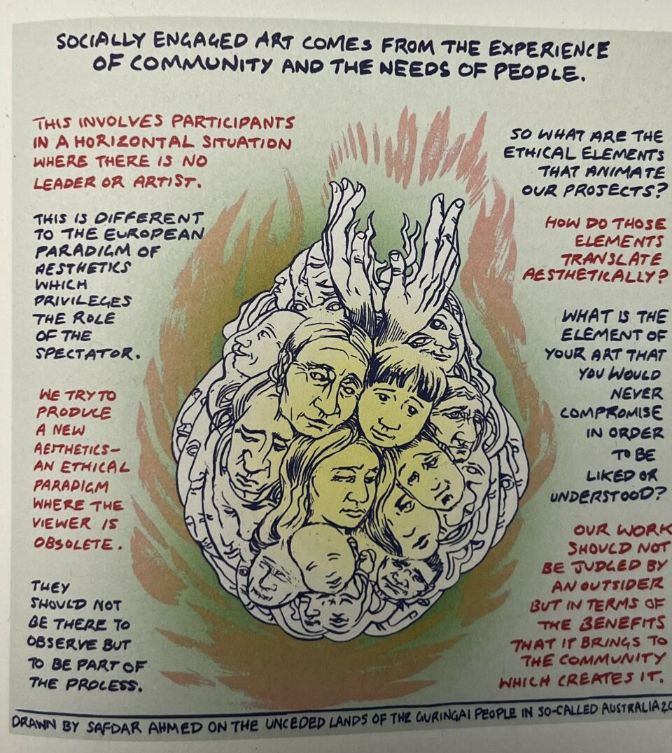 The focus is on art as process, and the artist as social activist who mediates between the artist’s engagement with social issues and the community.
“We want to create a globally oriented, collaborative and interdisciplinary art and culture platform that will remain effective beyond the 100 days of documenta fifteen. Our curatorial approach strives for a different kind of collaborative model of resource use–in economic terms but also with regard to ideas, knowledge, programs and innovations.” - ruangrupa
The artist is seen as mediator, and “now we are looking back and asking, ‘what is harvest?’”
14 lumbung members or artists collectives and 53 lumbung artists participate in documenta fifteen. In turn, these artists have been to include their networks.
ruangrupa and the artistic team are aware of the paradoxes in this event. In documenta fifteen, lumbung is still approaching the economy using old paradigms. documenta fifteen is still using the language of and can be understood as a conventional/mega event despite the artistic attempts to approach it as more bottom up. Notwithstanding, the aim here is ultimately the community,ruangrupa stated “lumbung is not only ours now… Own it, and make your own lumbung – ultimately, then, the energy and power of becoming and being is transmitted by the artistic experience transcending the boundaries which divide us to connect us in spirit. The practices and methodology are different.”
Thus, in the opening press conference, the artist Agus Nur Amal PM Toh informs us of his project with students in Kassel which facilitates a series of storytelling sessions based on the Sudanese life principles, Tri Tangua: “Public space contains a multitude of narratives, all competitions for how they can function as truth within the context of an authoritarian state or one where the powerless have no media access, native histories become a site to find answers.”
The focus is on art as process, and the artist as social activist who mediates between the artist’s engagement with social issues and the community.
“We want to create a globally oriented, collaborative and interdisciplinary art and culture platform that will remain effective beyond the 100 days of documenta fifteen. Our curatorial approach strives for a different kind of collaborative model of resource use–in economic terms but also with regard to ideas, knowledge, programs and innovations.” - ruangrupa
The artist is seen as mediator, and “now we are looking back and asking, ‘what is harvest?’”
14 lumbung members or artists collectives and 53 lumbung artists participate in documenta fifteen. In turn, these artists have been to include their networks.
ruangrupa and the artistic team are aware of the paradoxes in this event. In documenta fifteen, lumbung is still approaching the economy using old paradigms. documenta fifteen is still using the language of and can be understood as a conventional/mega event despite the artistic attempts to approach it as more bottom up. Notwithstanding, the aim here is ultimately the community,ruangrupa stated “lumbung is not only ours now… Own it, and make your own lumbung – ultimately, then, the energy and power of becoming and being is transmitted by the artistic experience transcending the boundaries which divide us to connect us in spirit. The practices and methodology are different.”
Thus, in the opening press conference, the artist Agus Nur Amal PM Toh informs us of his project with students in Kassel which facilitates a series of storytelling sessions based on the Sudanese life principles, Tri Tangua: “Public space contains a multitude of narratives, all competitions for how they can function as truth within the context of an authoritarian state or one where the powerless have no media access, native histories become a site to find answers.”
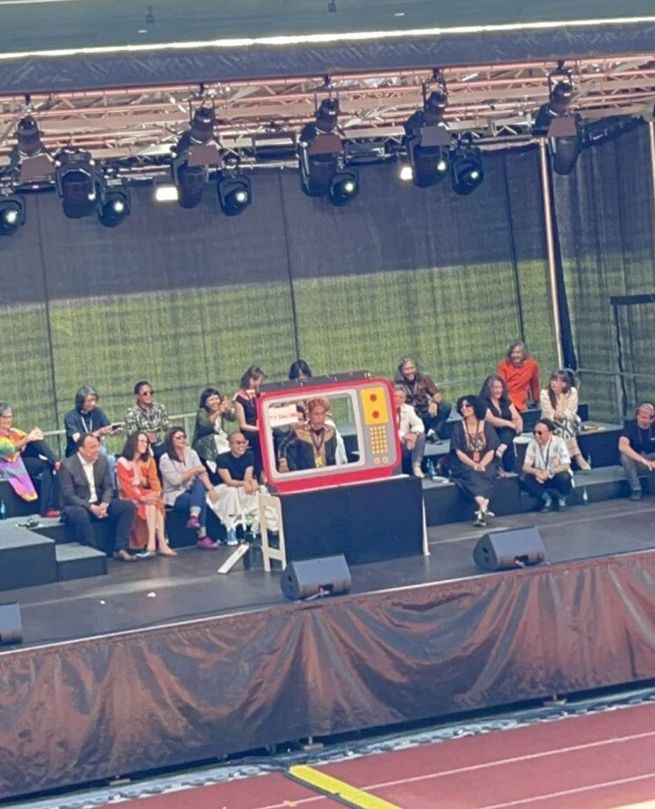 Press conference performance
documenta fifteen takes place in three geographic zones of Kassel: (1) Mitte, the central city part – museums, Fridericianum***, documenta halle***, WH 22; (2) Fulda – Hafenstrasse 76 and (3) Bettenhausen*** – The Fondation Festival Sur le Niger*** (Hubner-Areal) and Atis Rezistans | Ghetto Biennale *** (St. Kuniqundis).
*** Don’t miss these.
Fridericianum (Mitte)
For the duration of documenta fifteen, the former exhibition building has become Fridskul (Fridericianum as school) and is being used by artists and collectives to apply and demonstrate different models of horizontal education that are rooted in life. ruangrupa see it as a – a practice of sharing and a form of architecture often used to store harvests in Indonesian. As a lumbung, as both a domestic place and a social space where all can gather, the cold museum space of the Fridericianum becomes a warm and dynamic place. Artists are sleeping at Fridericianum, eat there communally and hold student encounters at the space.
Press conference performance
documenta fifteen takes place in three geographic zones of Kassel: (1) Mitte, the central city part – museums, Fridericianum***, documenta halle***, WH 22; (2) Fulda – Hafenstrasse 76 and (3) Bettenhausen*** – The Fondation Festival Sur le Niger*** (Hubner-Areal) and Atis Rezistans | Ghetto Biennale *** (St. Kuniqundis).
*** Don’t miss these.
Fridericianum (Mitte)
For the duration of documenta fifteen, the former exhibition building has become Fridskul (Fridericianum as school) and is being used by artists and collectives to apply and demonstrate different models of horizontal education that are rooted in life. ruangrupa see it as a – a practice of sharing and a form of architecture often used to store harvests in Indonesian. As a lumbung, as both a domestic place and a social space where all can gather, the cold museum space of the Fridericianum becomes a warm and dynamic place. Artists are sleeping at Fridericianum, eat there communally and hold student encounters at the space.
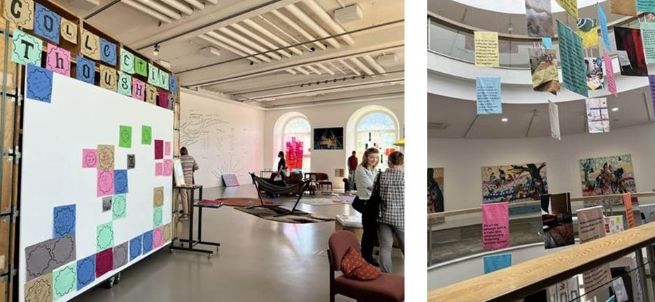 documenta Halle (Mitte)
Wajukuu Art Project
documenta fifteen advocates for the collective to substitute for art institutions. However, the idea of the collective making individual artworks is more complex and nuanced and warrants further discussion based on each collective's processes.
documenta Halle (Mitte)
Wajukuu Art Project
documenta fifteen advocates for the collective to substitute for art institutions. However, the idea of the collective making individual artworks is more complex and nuanced and warrants further discussion based on each collective's processes.
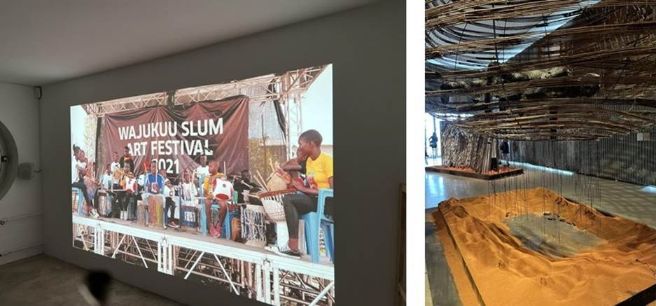 Wakjuu Art Project. Wakija Kwetu (When they come to our place), 2022. Mixed-media installation.
Artists in the Wajukuu Art Project have created not only as a collective but as these images reveal, have created powerful works of artistic authorship based on a new aesthetic of the slum and its materials. Wajukuu Art Project’s architectural installation is a tunnel inspired by both Makuru traditional housing and informal aesthetics of the slum. Aesthetic values rest on cultural heritage, cultural attitudes and accessibility of materials.
Britto Art Trust
The Bangladesh-based Britto Arts Trust creates a bazaar, a family kitchen and a large-scale mural all exploring geopolitics, land rights and food.
Wakjuu Art Project. Wakija Kwetu (When they come to our place), 2022. Mixed-media installation.
Artists in the Wajukuu Art Project have created not only as a collective but as these images reveal, have created powerful works of artistic authorship based on a new aesthetic of the slum and its materials. Wajukuu Art Project’s architectural installation is a tunnel inspired by both Makuru traditional housing and informal aesthetics of the slum. Aesthetic values rest on cultural heritage, cultural attitudes and accessibility of materials.
Britto Art Trust
The Bangladesh-based Britto Arts Trust creates a bazaar, a family kitchen and a large-scale mural all exploring geopolitics, land rights and food.
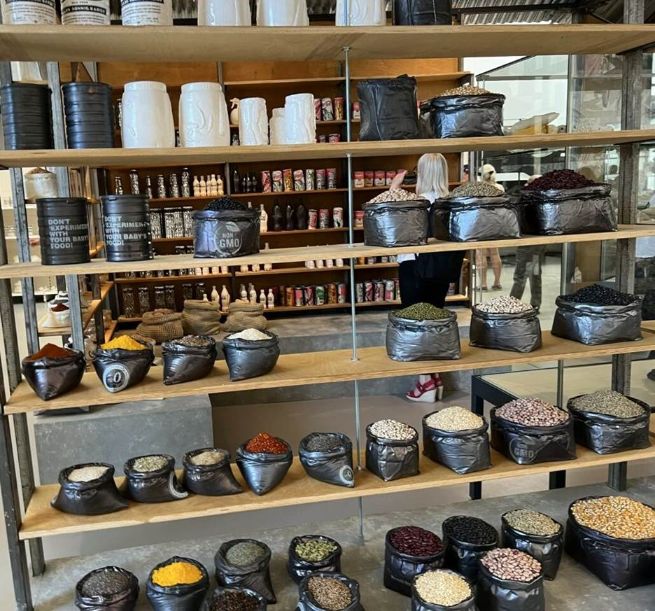 The small-town bazaar recreation rasad 2022 underscores how each hand made object becomes precious to the contrary of the reality where food stuffs are divorced from natural origins and survive only through chemical conditioning and false environments.
Bettenhausen
La Fondation Festival Sur le Niger (Hubner-Areal)
At this time of dislocation and social upheaval, global pandemic, the crumbling of our international legal order and its institutions, immigration, destruction of cultures in the wake of globalization, documenta provides guidance. The Fondation Festival Sur le Niger, founded in 2009 by Mamau Daffe and its individual artists, look to traditions, music and social practices as a means of identity and social cohesion.
The small-town bazaar recreation rasad 2022 underscores how each hand made object becomes precious to the contrary of the reality where food stuffs are divorced from natural origins and survive only through chemical conditioning and false environments.
Bettenhausen
La Fondation Festival Sur le Niger (Hubner-Areal)
At this time of dislocation and social upheaval, global pandemic, the crumbling of our international legal order and its institutions, immigration, destruction of cultures in the wake of globalization, documenta provides guidance. The Fondation Festival Sur le Niger, founded in 2009 by Mamau Daffe and its individual artists, look to traditions, music and social practices as a means of identity and social cohesion.
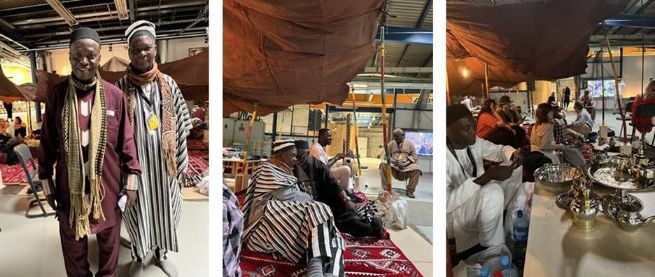 Guest and hosts at the presentation of the Maaya bulon and tea ceremony: Yaya Coulibaly, Abdoulaye Konate, Salia Male, Adama Keita, Mamou Daffe, founder. The degree of local support for the festival and the spirit of entrepeneurship is evident by the presence of the mayor of Sekou.
Performa, the New York performance Biennale introduced in its last biennale the importance of the role of architecture and architectural space as an element of visual performance artists. Traditional Malian culture recognized the bulon as a sacred space and social structure as early as 1653 with the founding of the Mali empire. The Bulon symbolizes the heart, the past, and the present of the family, a place of decision making and community with the ancestors. It is also a space for teaching and transformation. In this sense the Fridericianum also becomes a Bulon space. “True art,” writes Andre Breton, the Surrealist, “is the one that strives to give expression to the inner needs of man and humanity.” While Alemani's inquiry begins with and credits the Surrealists, for this new art aesthetic, documenta fifteen takes us to more ancient cultures. The Maaya is an integral concept of humanity based on the relationship of the individual and the community. This is a convergence of views where the function of art and social practice are the same.
Atis Rezistans | Ghetto Biennale (St. Kunigundis Church)
One of the most powerful installations is created by the collective Atis Rezistans from Haiti. A fluid collective of artists, working in the Grand Rue neighborhood of Port au Prince, Haiti, the collective was founded by sculptors Andre Eugene and Jean Herald Celeau in the late 1990’s. Coincidentally, my client in the famous case of AFP v. Morel was with Andre teaching art students during the 2010 earthquake that sparked the case that established photojournalist rights on the internet based on the Twitter TOS. The sculptures embody the spirit of the collective – the style derives from popular culture, Haitian history and voodoo using a range of found objects, mostly what is available in this country for artistic production.
Guest and hosts at the presentation of the Maaya bulon and tea ceremony: Yaya Coulibaly, Abdoulaye Konate, Salia Male, Adama Keita, Mamou Daffe, founder. The degree of local support for the festival and the spirit of entrepeneurship is evident by the presence of the mayor of Sekou.
Performa, the New York performance Biennale introduced in its last biennale the importance of the role of architecture and architectural space as an element of visual performance artists. Traditional Malian culture recognized the bulon as a sacred space and social structure as early as 1653 with the founding of the Mali empire. The Bulon symbolizes the heart, the past, and the present of the family, a place of decision making and community with the ancestors. It is also a space for teaching and transformation. In this sense the Fridericianum also becomes a Bulon space. “True art,” writes Andre Breton, the Surrealist, “is the one that strives to give expression to the inner needs of man and humanity.” While Alemani's inquiry begins with and credits the Surrealists, for this new art aesthetic, documenta fifteen takes us to more ancient cultures. The Maaya is an integral concept of humanity based on the relationship of the individual and the community. This is a convergence of views where the function of art and social practice are the same.
Atis Rezistans | Ghetto Biennale (St. Kunigundis Church)
One of the most powerful installations is created by the collective Atis Rezistans from Haiti. A fluid collective of artists, working in the Grand Rue neighborhood of Port au Prince, Haiti, the collective was founded by sculptors Andre Eugene and Jean Herald Celeau in the late 1990’s. Coincidentally, my client in the famous case of AFP v. Morel was with Andre teaching art students during the 2010 earthquake that sparked the case that established photojournalist rights on the internet based on the Twitter TOS. The sculptures embody the spirit of the collective – the style derives from popular culture, Haitian history and voodoo using a range of found objects, mostly what is available in this country for artistic production.
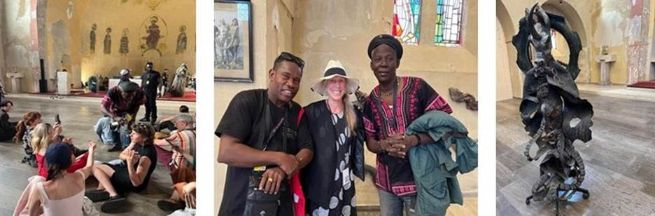 Barbara Hoffman with Evel Romain and founder Andre Eugene
There will be those who ask is this a proper role for documenta? This small sized town in Germany of under 250,000, for more than 75 years has provided intellectual content to the art world as an agent of thought and discussion. Could this have been a conference or a symposium? Maybe. But it is a work and experiment in art making that is important. It is, as was said, not the last documenta but the first lumbung.
The seeds of what is germinated here have yet to fully harvest. However, kernels can be found in artist activism in the U.S as either the practice or a practice of sharing with the community. One has only to look at the number of artist-endowed foundations, the renewed study and importance of archives, and the focus on artist residencies and leisure time, conversations and storytelling. Black Quantum Futurism, based in Philadelphia, is a documenta lumbung inter lokal member represented by three projects sourced in African diaspora, nonlinear temporalities, quantum physics and housing futures as framework. Numerous artist-endowed foundations supplement individual artistic practice to use foundations as a community-centered artistic practice or to provide artistic residencies for artists to think and reflect. Derrick Adam’s Charm City Cultural Cultivation Inc. embodies such lumbung themes as the importance of leisure time and conversation and the power of archives as identity to regenerate and cultivate the rich traditions and culture of Baltimore. Its Last Resort Artist Retreat residency subscribes to the concept of leisure as therapy for the black creative, Titus Kaphar’s NZTHVN, provides an arts model that empowers artists and curators, education and access to a vibrant ecosystem to create a sustainable art community in New Haven. Art as social practice and process - the spirit of lumbung- may not replace biennales or art fairs, but it is a present and a future and awaits the harvest.]]>
Barbara Hoffman with Evel Romain and founder Andre Eugene
There will be those who ask is this a proper role for documenta? This small sized town in Germany of under 250,000, for more than 75 years has provided intellectual content to the art world as an agent of thought and discussion. Could this have been a conference or a symposium? Maybe. But it is a work and experiment in art making that is important. It is, as was said, not the last documenta but the first lumbung.
The seeds of what is germinated here have yet to fully harvest. However, kernels can be found in artist activism in the U.S as either the practice or a practice of sharing with the community. One has only to look at the number of artist-endowed foundations, the renewed study and importance of archives, and the focus on artist residencies and leisure time, conversations and storytelling. Black Quantum Futurism, based in Philadelphia, is a documenta lumbung inter lokal member represented by three projects sourced in African diaspora, nonlinear temporalities, quantum physics and housing futures as framework. Numerous artist-endowed foundations supplement individual artistic practice to use foundations as a community-centered artistic practice or to provide artistic residencies for artists to think and reflect. Derrick Adam’s Charm City Cultural Cultivation Inc. embodies such lumbung themes as the importance of leisure time and conversation and the power of archives as identity to regenerate and cultivate the rich traditions and culture of Baltimore. Its Last Resort Artist Retreat residency subscribes to the concept of leisure as therapy for the black creative, Titus Kaphar’s NZTHVN, provides an arts model that empowers artists and curators, education and access to a vibrant ecosystem to create a sustainable art community in New Haven. Art as social practice and process - the spirit of lumbung- may not replace biennales or art fairs, but it is a present and a future and awaits the harvest.]]>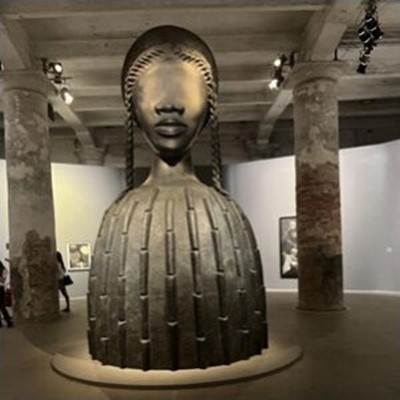 Images from Milk of Dreams Illustrate Alemani’s Curatorial Perspective at Venice Art Biennale
Simon Leigh, USA (2022). The entrance to the Milk of Dreams Exhibition at the Arsenal.
Images from Milk of Dreams Illustrate Alemani’s Curatorial Perspective at Venice Art Biennale
Simon Leigh, USA (2022). The entrance to the Milk of Dreams Exhibition at the Arsenal.
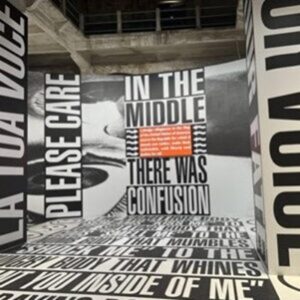 Central Pavilion. Barbara Kruger, Untitled. Beginning, Middle End.
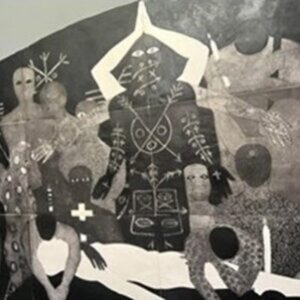 Homage to Belkis Ayon. La consagracion, Havana, Cuba. Arsenales.
documenta fifteen
Founded in 1955 in Kassel, Germany, documenta is a quinquennial international art exhibition that carries heavy intellectual weight in the art world, customarily programmed for a duration of 100 days in venues throughout Kassel. While held in high regard among artists, curators and institutional directors, perhaps less so among collectors and dealers given its often more academic, intellectual and less market-friendly nature. Normally, the artistic director is a well-recognized international curator: Adam Szymczyk (14); Catherine David,Pompidou Paris 1997 (10); and Okwui Enwezor 2002 (11).
Breaking with this tradition, documenta fifteen poses a radical artistic response to the world’s crisis, at first encounter, a seismic shift in envisioning not only the role of the site and the exhibition, but the very role of the artist and the systems of art production. documenta fifteen is not theme based. It is about process and practice: how do people create the material and immaterial infrastructure they need to nurture and sustain themselves and their ecosystems?
documenta fifteen takes place from June 18 to September 25, 2022, under the Artistic Direction of ruangrupa at 32 venues in Kassel, Germany. The Jakarta-based artist collective has built the foundation of documenta’s fifteenth edition on the core values and ideas of lumbung, the Indonesian term for a communal rice barn.
The Indonesian word ruangrupa loosely translates as “art space.” ruangrupa’s work is based on a holistic social, spatial and personal practice that is strongly rooted in Indonesian culture, where friendship’s solidarity and community are of central importance.
lumbung as an artistic and economic model is rooted in principles such as collectivity, communal resource sharing, and equal allocation and is embodied in all parts of the collaboration and the exhibition. lumbung is the concrete practice adopted by ruangrupa and the Artistic Team, lumbung members and lumbung artists and all participants on the path towards documenta fifteen, throughout its 100 days and beyond.
Homage to Belkis Ayon. La consagracion, Havana, Cuba. Arsenales.
documenta fifteen
Founded in 1955 in Kassel, Germany, documenta is a quinquennial international art exhibition that carries heavy intellectual weight in the art world, customarily programmed for a duration of 100 days in venues throughout Kassel. While held in high regard among artists, curators and institutional directors, perhaps less so among collectors and dealers given its often more academic, intellectual and less market-friendly nature. Normally, the artistic director is a well-recognized international curator: Adam Szymczyk (14); Catherine David,Pompidou Paris 1997 (10); and Okwui Enwezor 2002 (11).
Breaking with this tradition, documenta fifteen poses a radical artistic response to the world’s crisis, at first encounter, a seismic shift in envisioning not only the role of the site and the exhibition, but the very role of the artist and the systems of art production. documenta fifteen is not theme based. It is about process and practice: how do people create the material and immaterial infrastructure they need to nurture and sustain themselves and their ecosystems?
documenta fifteen takes place from June 18 to September 25, 2022, under the Artistic Direction of ruangrupa at 32 venues in Kassel, Germany. The Jakarta-based artist collective has built the foundation of documenta’s fifteenth edition on the core values and ideas of lumbung, the Indonesian term for a communal rice barn.
The Indonesian word ruangrupa loosely translates as “art space.” ruangrupa’s work is based on a holistic social, spatial and personal practice that is strongly rooted in Indonesian culture, where friendship’s solidarity and community are of central importance.
lumbung as an artistic and economic model is rooted in principles such as collectivity, communal resource sharing, and equal allocation and is embodied in all parts of the collaboration and the exhibition. lumbung is the concrete practice adopted by ruangrupa and the Artistic Team, lumbung members and lumbung artists and all participants on the path towards documenta fifteen, throughout its 100 days and beyond.
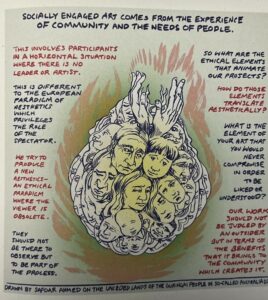 The focus is on art as process, and the artist as social activist who mediates between the artist’s engagement with social issues and the community.
“We want to create a globally oriented, collaborative and interdisciplinary art and culture platform that will remain effective beyond the 100 days of documenta fifteen. Our curatorial approach strives for a different kind of collaborative model of resource use–in economic terms but also with regard to ideas, knowledge, programs and innovations.” - ruangrupa
The artist is seen as mediator, and “now we are looking back and asking, ‘what is harvest?’”
14 lumbung members or artists collectives and 53 lumbung artists participate in documenta fifteen. In turn, these artists have been to include their networks.
ruangrupa and the artistic team are aware of the paradoxes in this event. In documenta fifteen, lumbung is still approaching the economy using old paradigms. documenta fifteen is still using the language of and can be understood as a conventional/mega event despite the artistic attempts to approach it as more bottom up. Notwithstanding, the aim here is ultimately the community,ruangrupa stated “lumbung is not only ours now… Own it, and make your own lumbung – ultimately, then, the energy and power of becoming and being is transmitted by the artistic experience transcending the boundaries which divide us to connect us in spirit. The practices and methodology are different.”
Thus, in the opening press conference, the artist Agus Nur Amal PM Toh informs us of his project with students in Kassel which facilitates a series of storytelling sessions based on the Sudanese life principles, Tri Tangua: “Public space contains a multitude of narratives, all competitions for how they can function as truth within the context of an authoritarian state or one where the powerless have no media access, native histories become a site to find answers.”
The focus is on art as process, and the artist as social activist who mediates between the artist’s engagement with social issues and the community.
“We want to create a globally oriented, collaborative and interdisciplinary art and culture platform that will remain effective beyond the 100 days of documenta fifteen. Our curatorial approach strives for a different kind of collaborative model of resource use–in economic terms but also with regard to ideas, knowledge, programs and innovations.” - ruangrupa
The artist is seen as mediator, and “now we are looking back and asking, ‘what is harvest?’”
14 lumbung members or artists collectives and 53 lumbung artists participate in documenta fifteen. In turn, these artists have been to include their networks.
ruangrupa and the artistic team are aware of the paradoxes in this event. In documenta fifteen, lumbung is still approaching the economy using old paradigms. documenta fifteen is still using the language of and can be understood as a conventional/mega event despite the artistic attempts to approach it as more bottom up. Notwithstanding, the aim here is ultimately the community,ruangrupa stated “lumbung is not only ours now… Own it, and make your own lumbung – ultimately, then, the energy and power of becoming and being is transmitted by the artistic experience transcending the boundaries which divide us to connect us in spirit. The practices and methodology are different.”
Thus, in the opening press conference, the artist Agus Nur Amal PM Toh informs us of his project with students in Kassel which facilitates a series of storytelling sessions based on the Sudanese life principles, Tri Tangua: “Public space contains a multitude of narratives, all competitions for how they can function as truth within the context of an authoritarian state or one where the powerless have no media access, native histories become a site to find answers.”
 Press conference performance
documenta fifteen takes place in three geographic zones of Kassel: (1) Mitte, the central city part – museums, Fridericianum***, documenta halle***, WH 22; (2) Fulda – Hafenstrasse 76 and (3) Bettenhausen*** – The Fondation Festival Sur le Niger*** (Hubner-Areal) and Atis Rezistans | Ghetto Biennale *** (St. Kuniqundis).
*** Don’t miss these.
Fridericianum (Mitte)
For the duration of documenta fifteen, the former exhibition building has become Fridskul (Fridericianum as school) and is being used by artists and collectives to apply and demonstrate different models of horizontal education that are rooted in life. ruangrupa see it as a – a practice of sharing and a form of architecture often used to store harvests in Indonesian. As a lumbung, as both a domestic place and a social space where all can gather, the cold museum space of the Fridericianum becomes a warm and dynamic place. Artists are sleeping at Fridericianum, eat there communally and hold student encounters at the space.
Press conference performance
documenta fifteen takes place in three geographic zones of Kassel: (1) Mitte, the central city part – museums, Fridericianum***, documenta halle***, WH 22; (2) Fulda – Hafenstrasse 76 and (3) Bettenhausen*** – The Fondation Festival Sur le Niger*** (Hubner-Areal) and Atis Rezistans | Ghetto Biennale *** (St. Kuniqundis).
*** Don’t miss these.
Fridericianum (Mitte)
For the duration of documenta fifteen, the former exhibition building has become Fridskul (Fridericianum as school) and is being used by artists and collectives to apply and demonstrate different models of horizontal education that are rooted in life. ruangrupa see it as a – a practice of sharing and a form of architecture often used to store harvests in Indonesian. As a lumbung, as both a domestic place and a social space where all can gather, the cold museum space of the Fridericianum becomes a warm and dynamic place. Artists are sleeping at Fridericianum, eat there communally and hold student encounters at the space.
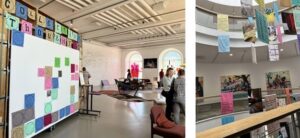 documenta Halle (Mitte)
Wajukuu Art Project
documenta fifteen advocates for the collective to substitute for art institutions. However, the idea of the collective making individual artworks is more complex and nuanced and warrants further discussion based on each collective's processes.
documenta Halle (Mitte)
Wajukuu Art Project
documenta fifteen advocates for the collective to substitute for art institutions. However, the idea of the collective making individual artworks is more complex and nuanced and warrants further discussion based on each collective's processes.
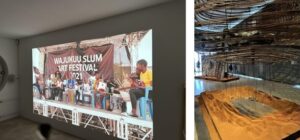 Wakjuu Art Project. Wakija Kwetu (When they come to our place), 2022. Mixed-media installation.
Artists in the Wajukuu Art Project have created not only as a collective but as these images reveal, have created powerful works of artistic authorship based on a new aesthetic of the slum and its materials. Wajukuu Art Project’s architectural installation is a tunnel inspired by both Makuru traditional housing and informal aesthetics of the slum. Aesthetic values rest on cultural heritage, cultural attitudes and accessibility of materials.
Britto Art Trust
The Bangladesh-based Britto Arts Trust creates a bazaar, a family kitchen and a large-scale mural all exploring geopolitics, land rights and food.
Wakjuu Art Project. Wakija Kwetu (When they come to our place), 2022. Mixed-media installation.
Artists in the Wajukuu Art Project have created not only as a collective but as these images reveal, have created powerful works of artistic authorship based on a new aesthetic of the slum and its materials. Wajukuu Art Project’s architectural installation is a tunnel inspired by both Makuru traditional housing and informal aesthetics of the slum. Aesthetic values rest on cultural heritage, cultural attitudes and accessibility of materials.
Britto Art Trust
The Bangladesh-based Britto Arts Trust creates a bazaar, a family kitchen and a large-scale mural all exploring geopolitics, land rights and food.
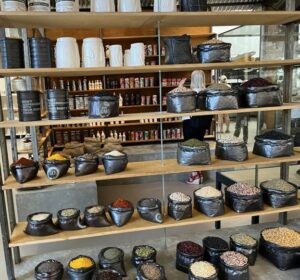 The small-town bazaar recreation rasad 2022 underscores how each hand made object becomes precious to the contrary of the reality where food stuffs are divorced from natural origins and survive only through chemical conditioning and false environments.
Bettenhausen
La Fondation Festival Sur le Niger (Hubner-Areal)
At this time of dislocation and social upheaval, global pandemic, the crumbling of our international legal order and its institutions, immigration, destruction of cultures in the wake of globalization, documenta provides guidance. The Fondation Festival Sur le Niger, founded in 2009 by Mamau Daffe and its individual artists, look to traditions, music and social practices as a means of identity and social cohesion.
The small-town bazaar recreation rasad 2022 underscores how each hand made object becomes precious to the contrary of the reality where food stuffs are divorced from natural origins and survive only through chemical conditioning and false environments.
Bettenhausen
La Fondation Festival Sur le Niger (Hubner-Areal)
At this time of dislocation and social upheaval, global pandemic, the crumbling of our international legal order and its institutions, immigration, destruction of cultures in the wake of globalization, documenta provides guidance. The Fondation Festival Sur le Niger, founded in 2009 by Mamau Daffe and its individual artists, look to traditions, music and social practices as a means of identity and social cohesion.
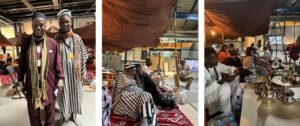 Guest and hosts at the presentation of the Maaya bulon and tea ceremony: Yaya Coulibaly, Abdoulaye Konate, Salia Male, Adama Keita, Mamou Daffe, founder. The degree of local support for the festival and the spirit of entrepeneurship is evident by the presence of the mayor of Sekou.
Performa, the New York performance Biennale introduced in its last biennale the importance of the role of architecture and architectural space as an element of visual performance artists. Traditional Malian culture recognized the bulon as a sacred space and social structure as early as 1653 with the founding of the Mali empire. The Bulon symbolizes the heart, the past, and the present of the family, a place of decision making and community with the ancestors. It is also a space for teaching and transformation. In this sense the Fridericianum also becomes a Bulon space. “True art,” writes Andre Breton, the Surrealist, “is the one that strives to give expression to the inner needs of man and humanity.” While Alemani's inquiry begins with and credits the Surrealists, for this new art aesthetic, documenta fifteen takes us to more ancient cultures. The Maaya is an integral concept of humanity based on the relationship of the individual and the community. This is a convergence of views where the function of art and social practice are the same.
Atis Rezistans | Ghetto Biennale (St. Kunigundis Church)
One of the most powerful installations is created by the collective Atis Rezistans from Haiti. A fluid collective of artists, working in the Grand Rue neighborhood of Port au Prince, Haiti, the collective was founded by sculptors Andre Eugene and Jean Herald Celeau in the late 1990’s. Coincidentally, my client in the famous case of AFP v. Morel was with Andre teaching art students during the 2010 earthquake that sparked the case that established photojournalist rights on the internet based on the Twitter TOS. The sculptures embody the spirit of the collective – the style derives from popular culture, Haitian history and voodoo using a range of found objects, mostly what is available in this country for artistic production.
Guest and hosts at the presentation of the Maaya bulon and tea ceremony: Yaya Coulibaly, Abdoulaye Konate, Salia Male, Adama Keita, Mamou Daffe, founder. The degree of local support for the festival and the spirit of entrepeneurship is evident by the presence of the mayor of Sekou.
Performa, the New York performance Biennale introduced in its last biennale the importance of the role of architecture and architectural space as an element of visual performance artists. Traditional Malian culture recognized the bulon as a sacred space and social structure as early as 1653 with the founding of the Mali empire. The Bulon symbolizes the heart, the past, and the present of the family, a place of decision making and community with the ancestors. It is also a space for teaching and transformation. In this sense the Fridericianum also becomes a Bulon space. “True art,” writes Andre Breton, the Surrealist, “is the one that strives to give expression to the inner needs of man and humanity.” While Alemani's inquiry begins with and credits the Surrealists, for this new art aesthetic, documenta fifteen takes us to more ancient cultures. The Maaya is an integral concept of humanity based on the relationship of the individual and the community. This is a convergence of views where the function of art and social practice are the same.
Atis Rezistans | Ghetto Biennale (St. Kunigundis Church)
One of the most powerful installations is created by the collective Atis Rezistans from Haiti. A fluid collective of artists, working in the Grand Rue neighborhood of Port au Prince, Haiti, the collective was founded by sculptors Andre Eugene and Jean Herald Celeau in the late 1990’s. Coincidentally, my client in the famous case of AFP v. Morel was with Andre teaching art students during the 2010 earthquake that sparked the case that established photojournalist rights on the internet based on the Twitter TOS. The sculptures embody the spirit of the collective – the style derives from popular culture, Haitian history and voodoo using a range of found objects, mostly what is available in this country for artistic production.
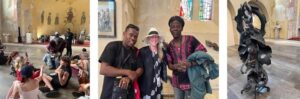 Barbara Hoffman with Evel Romain and founder Andre Eugene
There will be those who ask is this a proper role for documenta? This small sized town in Germany of under 250,000, for more than 75 years has provided intellectual content to the art world as an agent of thought and discussion. Could this have been a conference or a symposium? Maybe. But it is a work and experiment in art making that is important. It is, as was said, not the last documenta but the first lumbung.
The seeds of what is germinated here have yet to fully harvest. However, kernels can be found in artist activism in the U.S as either the practice or a practice of sharing with the community. One has only to look at the number of artist-endowed foundations, the renewed study and importance of archives, and the focus on artist residencies and leisure time, conversations and storytelling. Black Quantum Futurism, based in Philadelphia, is a documenta lumbung inter lokal member represented by three projects sourced in African diaspora, nonlinear temporalities, quantum physics and housing futures as framework. Numerous artist-endowed foundations supplement individual artistic practice to use foundations as a community-centered artistic practice or to provide artistic residencies for artists to think and reflect. Derrick Adam’s Charm City Cultural Cultivation Inc. embodies such lumbung themes as the importance of leisure time and conversation and the power of archives as identity to regenerate and cultivate the rich traditions and culture of Baltimore. Its Last Resort Artist Retreat residency subscribes to the concept of leisure as therapy for the black creative, Titus Kaphar’s NZTHVN, provides an arts model that empowers artists and curators, education and access to a vibrant ecosystem to create a sustainable art community in New Haven. Art as social practice and process - the spirit of lumbung- may not replace biennales or art fairs, but it is a present and a future and awaits the harvest.]]>
Barbara Hoffman with Evel Romain and founder Andre Eugene
There will be those who ask is this a proper role for documenta? This small sized town in Germany of under 250,000, for more than 75 years has provided intellectual content to the art world as an agent of thought and discussion. Could this have been a conference or a symposium? Maybe. But it is a work and experiment in art making that is important. It is, as was said, not the last documenta but the first lumbung.
The seeds of what is germinated here have yet to fully harvest. However, kernels can be found in artist activism in the U.S as either the practice or a practice of sharing with the community. One has only to look at the number of artist-endowed foundations, the renewed study and importance of archives, and the focus on artist residencies and leisure time, conversations and storytelling. Black Quantum Futurism, based in Philadelphia, is a documenta lumbung inter lokal member represented by three projects sourced in African diaspora, nonlinear temporalities, quantum physics and housing futures as framework. Numerous artist-endowed foundations supplement individual artistic practice to use foundations as a community-centered artistic practice or to provide artistic residencies for artists to think and reflect. Derrick Adam’s Charm City Cultural Cultivation Inc. embodies such lumbung themes as the importance of leisure time and conversation and the power of archives as identity to regenerate and cultivate the rich traditions and culture of Baltimore. Its Last Resort Artist Retreat residency subscribes to the concept of leisure as therapy for the black creative, Titus Kaphar’s NZTHVN, provides an arts model that empowers artists and curators, education and access to a vibrant ecosystem to create a sustainable art community in New Haven. Art as social practice and process - the spirit of lumbung- may not replace biennales or art fairs, but it is a present and a future and awaits the harvest.]]>
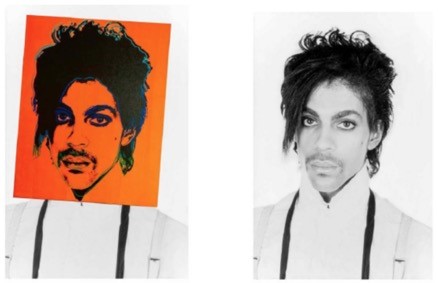
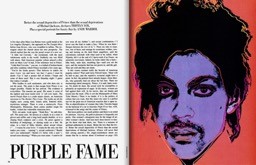
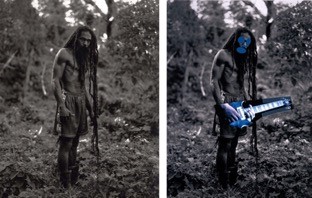
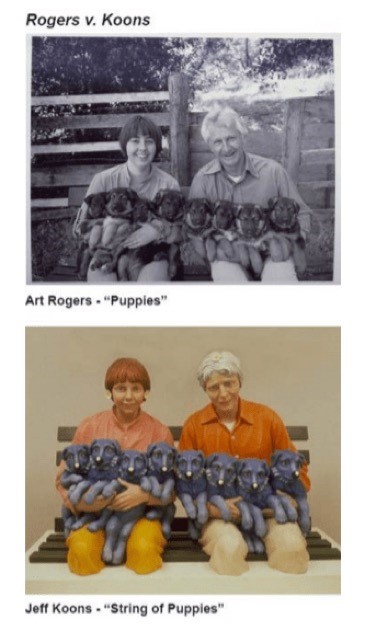


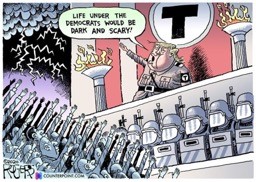
 © Derrick Adams 2020
Derrick Adam's illustration above was born out of a collaboration with award-winning restaurateur, philanthropist and food activist Marcus Samuelsson, who shared the image on his Instagram, writing:
The Black community is battling two pandemics right now — coronavirus and racism. My friend @derrickadamsny and I created Take 3 to act as a guide for keeping your head straight and pushing through. The steps we feel are most imperative are:
MOURN - COVID-19 has killed Black folks 3x more than anyone else. Not only that, we continue to see race related killings and unjust police brutality. What we’re going through is a travesty. It’s extremely important that you give yourself time to grieve.
REFLECT - Think about how we got here. Consider the 400+ years of injustice that lead us to this place. Lastly, think about how we all as people and as communities can create positive change for ourselves and our country.
COMPASSION - Empathy and love for all people is a must, especially during these trying times. Think about what you can do for someone else — we have to be a positive influence for our family, our neighbors, and our community.
We are watching American history right in front of our eyes. I’m so inspired by the diversity of all the peaceful protesters, the different ages, cultures, and backgrounds. It’s been incredible to watch the response on a global scale as well — thank you Stockholm, Paris, London, and others. If you can’t hit the streets, one of the most impactful things you can do is VOTE! You don’t want to be on the sidelines and tell your (future) children that you didn’t contribute. Just like Sam Cooke said, a change is gonna come. Please share this post and urge someone to Take 3 steps in order to stay well and keep going. What steps are you taking to push through during this time?
© Derrick Adams 2020
Derrick Adam's illustration above was born out of a collaboration with award-winning restaurateur, philanthropist and food activist Marcus Samuelsson, who shared the image on his Instagram, writing:
The Black community is battling two pandemics right now — coronavirus and racism. My friend @derrickadamsny and I created Take 3 to act as a guide for keeping your head straight and pushing through. The steps we feel are most imperative are:
MOURN - COVID-19 has killed Black folks 3x more than anyone else. Not only that, we continue to see race related killings and unjust police brutality. What we’re going through is a travesty. It’s extremely important that you give yourself time to grieve.
REFLECT - Think about how we got here. Consider the 400+ years of injustice that lead us to this place. Lastly, think about how we all as people and as communities can create positive change for ourselves and our country.
COMPASSION - Empathy and love for all people is a must, especially during these trying times. Think about what you can do for someone else — we have to be a positive influence for our family, our neighbors, and our community.
We are watching American history right in front of our eyes. I’m so inspired by the diversity of all the peaceful protesters, the different ages, cultures, and backgrounds. It’s been incredible to watch the response on a global scale as well — thank you Stockholm, Paris, London, and others. If you can’t hit the streets, one of the most impactful things you can do is VOTE! You don’t want to be on the sidelines and tell your (future) children that you didn’t contribute. Just like Sam Cooke said, a change is gonna come. Please share this post and urge someone to Take 3 steps in order to stay well and keep going. What steps are you taking to push through during this time?
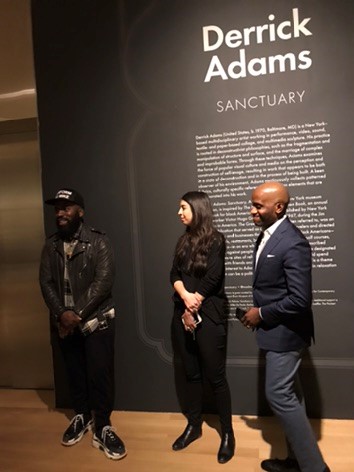 Friends have asked me to link again to my February 2018 edition of The Art Lawyer's Diary, A Call to Action and an Opening, which was inspired by attending a screening of the film 13th by Ava DuVernay, and the opening that evening of Derrick's exhibition Sanctuary at the Museum of Arts and Design in January 2018.
Derrick's work always presents a positive view of Black culture - in this case, leisure travel. The exhibition is inspired by The Green Book, which Derrick discovered at the Schomburg Center: "From 1936 to 1966, Victor Hugo Green, a postal worker who worked in New Jersey and lived in Harlem, published the directories known today as the Green Book. The books listed hotels, restaurants, beauty salons, nightclubs, bars, and gas stations where Black travelers would be welcome. In an age of sundown towns, segregation, and lynching, the Green Book became an indispensable tool for safe navigation." See History of the Green Book: Ways to Explore the Schomburg Center's Collection of Victor Hugo Green's Green Books.
A brilliant conversation with Pulitzer Prize -winner Isabel Wilkerson organized by MAD discussing her book, The Warmth of Other Suns: The Epic Story of America's Great Migration, gave factual depth to the theme of Derrick's exhibition, and is a timely read for a deeper understanding of this moment. I look with anticipation to her forthcoming book Caste: The Origins of Our Discontents, scheduled for release in August, a study of the unspoken caste system that has shaped America and shows how our lives today are still defined by a hierarchy of human divisions.
Friends have asked me to link again to my February 2018 edition of The Art Lawyer's Diary, A Call to Action and an Opening, which was inspired by attending a screening of the film 13th by Ava DuVernay, and the opening that evening of Derrick's exhibition Sanctuary at the Museum of Arts and Design in January 2018.
Derrick's work always presents a positive view of Black culture - in this case, leisure travel. The exhibition is inspired by The Green Book, which Derrick discovered at the Schomburg Center: "From 1936 to 1966, Victor Hugo Green, a postal worker who worked in New Jersey and lived in Harlem, published the directories known today as the Green Book. The books listed hotels, restaurants, beauty salons, nightclubs, bars, and gas stations where Black travelers would be welcome. In an age of sundown towns, segregation, and lynching, the Green Book became an indispensable tool for safe navigation." See History of the Green Book: Ways to Explore the Schomburg Center's Collection of Victor Hugo Green's Green Books.
A brilliant conversation with Pulitzer Prize -winner Isabel Wilkerson organized by MAD discussing her book, The Warmth of Other Suns: The Epic Story of America's Great Migration, gave factual depth to the theme of Derrick's exhibition, and is a timely read for a deeper understanding of this moment. I look with anticipation to her forthcoming book Caste: The Origins of Our Discontents, scheduled for release in August, a study of the unspoken caste system that has shaped America and shows how our lives today are still defined by a hierarchy of human divisions.
 13th is Ava DuVernay's powerful, not to be missed documentary, explaining how we got from the 13th amendment, which provides that "Neither slavery nor involuntary servitude, except as a punishment for crime whereof the party shall have been duly convicted," to mass incarceration by way of consistently branding African American men from its enactment to the present as criminals. According to 13th, the costumes for white supremacists in D.W. Griffith's 1915 Birth of a Nation inspired the garments of the Klu Klux Klan.
 Also not to miss is the timely docu-drama Just Mercy about injustice in the criminal justice system and the efforts of civil rights lawyer Bryan Stevenson, founder and Executive Director of the Equal Justice Initiative in Alabama, to defend Black Americans on death row. Stars Michael B. Jordan, Jamie Foxx, and Brie Larson. Streams free during June. Link from Letty Cottin Pogrebin's newsletter.
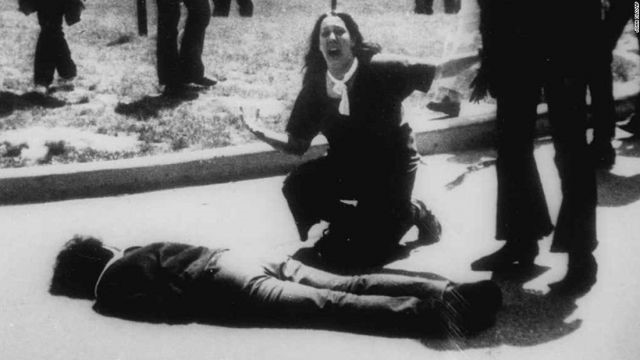
 State of Affairs, 2020. © Chester Higgins Archives. All Rights Reserved.
My friend Chester Higgins, an award-winning New York Times photographer, shared the above image with me. He writes: "for me, [this image] illustrates the State of Affairs where too often African Americans exist behind the borders of indifference and extensive hatred. Congress needs to pass laws that take away the immunity that police have for lethal force."
You can find Chester Higgins' photography here.
State of Affairs, 2020. © Chester Higgins Archives. All Rights Reserved.
My friend Chester Higgins, an award-winning New York Times photographer, shared the above image with me. He writes: "for me, [this image] illustrates the State of Affairs where too often African Americans exist behind the borders of indifference and extensive hatred. Congress needs to pass laws that take away the immunity that police have for lethal force."
You can find Chester Higgins' photography here.
 An artist-activist friend shared this image with me of a Frederick Douglass quotation she painted as part of the Art 2♥SoHo project, which brought together over 100 artists last weekend and this weekend to paint the boarded-up storefronts in SoHo.
Maxi Cohen wrote of the project: "Over 100 artists showed up, from UNLOK artist Gordon Kindlon to a founder of the Guerrilla Girls to Bobbi Van sending artwork from Mexico. Painters included an 8-year-old spanning to a 78-year-old, from Egypt, Greece, China, Harlem, and Brooklyn, people of every color, artists from the neighborhood who were here since the early 70s to their children and grandchildren. People were so happy to have some relief painting and the images were all longings of the heart."
An artist-activist friend shared this image with me of a Frederick Douglass quotation she painted as part of the Art 2♥SoHo project, which brought together over 100 artists last weekend and this weekend to paint the boarded-up storefronts in SoHo.
Maxi Cohen wrote of the project: "Over 100 artists showed up, from UNLOK artist Gordon Kindlon to a founder of the Guerrilla Girls to Bobbi Van sending artwork from Mexico. Painters included an 8-year-old spanning to a 78-year-old, from Egypt, Greece, China, Harlem, and Brooklyn, people of every color, artists from the neighborhood who were here since the early 70s to their children and grandchildren. People were so happy to have some relief painting and the images were all longings of the heart."
 See also the work of We Make America, a group composed of activist-artists committed to making artwork, banners and signs for marches, actions, and other projects.
Tuning in to how artists are responding to this moment is a source of great inspiration. Live at Lincoln Center is doing amazing programming right now, tying present events to the history of the civil rights movement. See Freedom by Celisse, a song Celisse wrote in July 2016 following the deaths of Philando Castile and Alton Sterling, which remains a rallying cry to fight systemic injustice, and Soundtrack '63, a live, multimedia musical performance about the African-American experience in America. See also Asia Society's Diversity and Inclusion program. Click here to register directly.
See also the work of We Make America, a group composed of activist-artists committed to making artwork, banners and signs for marches, actions, and other projects.
Tuning in to how artists are responding to this moment is a source of great inspiration. Live at Lincoln Center is doing amazing programming right now, tying present events to the history of the civil rights movement. See Freedom by Celisse, a song Celisse wrote in July 2016 following the deaths of Philando Castile and Alton Sterling, which remains a rallying cry to fight systemic injustice, and Soundtrack '63, a live, multimedia musical performance about the African-American experience in America. See also Asia Society's Diversity and Inclusion program. Click here to register directly.
 A fellow member of the Explorers Club, my friend J.R. Harris, an African American former fortune-500 marketing executive and club member of 25 years, wrote an excellent memoir titled Way Out There: Adventures of a Wilderness Trekker, Mountaineers Books (2017). It is an account of his exploits while backpacking in some of the most rugged and remote places on earth. Prior to the pandemic, J.R. was retained as part of a U.S. Forest Service initiative, and traveled to North Carolina and Texas to interview African Americans and Hispanics about their experiences, or lack thereof, in spending time in national forests and other public lands. With this information he intends to develop a marketing and advertising plan to get more people of color, including children, into the great outdoors.
 Dr. Allen Counter, a friend from the Explorers Club, was a distinguished African American explorer and a fellow of the club who passed away in 2017. He received a 2013 Lowell Thomas Award, recognizing “the principle of justice and right action in field exploration."
It took his personal efforts to reclaim the reputation of African American explorer Matthew Henson, who reached the North Pole with Robert Peary in 1909, but received little credit until Dr. Counter dedicated his field research to gaining recognition for him. Dr. Counter's book on Henson is North Pole Legacy: Black, White, and Eskimo (Invisible Cities Press, 1991).
Dr. Allen Counter, a friend from the Explorers Club, was a distinguished African American explorer and a fellow of the club who passed away in 2017. He received a 2013 Lowell Thomas Award, recognizing “the principle of justice and right action in field exploration."
It took his personal efforts to reclaim the reputation of African American explorer Matthew Henson, who reached the North Pole with Robert Peary in 1909, but received little credit until Dr. Counter dedicated his field research to gaining recognition for him. Dr. Counter's book on Henson is North Pole Legacy: Black, White, and Eskimo (Invisible Cities Press, 1991).